Authority Console¶
The Authority Console is the single admin surface for viewing, managing, and editing authorities — the bodies of law (USC titles, CFR parts, statutes, regulations, administrative regimes) whose aliases drive citation extraction and whose corpora can be installed and sideloaded as reusable packs. It lives at /admin/authority and is superuser-gated.
It is the management layer for the open-vocabulary authority-discovery engine described in Reference-Web Enrichment & Authority Discovery; for runnable ingestion procedures see Ingesting Authorities & Adding Providers.
Overview¶
The discovery pipeline (taxonomy, shape grammars, the source-provider registry, the crawl frontier) shipped well-factored, but its management was scattered across several mechanisms with no unifying concept of "an authority":
| Concern | Before | Now |
|---|---|---|
| Authority packs | management-command-only installation | Authority Packs catalog, preflight, install, and targeted corpus sideload |
AuthorityNamespace (the body-of-law registry) | no API/admin/GUI — hand-edit authority_mappings.yaml + re-run the loader | Registry tab + AuthorityNamespaceService |
AuthorityKeyEquivalence (aliases/relationships) | standalone AuthorityMappings panel | Aliases & Relationships tab |
AuthorityFrontier (discovery queue) | read-only AuthoritySourcesMonitor panel | Discovery Queue tab (now with action verbs) |
| Source providers ("scrapers") | code-only, invisible to the API | Scrapers & Credentials tab |
| Enrichment runs | standalone AdminEnrichment page | Runs tab |
The console consolidates these concerns behind one tabbed front door. The three standalone panels (AuthorityMappings, AuthoritySourcesMonitor, AdminEnrichment) were deleted; GlobalSettingsPanel's three separate admin cards collapsed into one Authority Console card.
The organizing principle is AuthorityNamespace-as-spine: every link between the authority models is a string join on the canonical-key prefix (there are no foreign keys between them), so a registry keyed on the namespace prefix is literally the join root. Genuinely instance-wide concerns (the whole frontier queue, the provider registry, run history) get honest sibling tabs at their natural altitude rather than being crammed into per-authority drawers.
The console & its tabs¶
AuthorityConsole (frontend/src/components/admin/authority/AuthorityConsole.tsx) is mounted at one wildcard route, /admin/authority/*, and parses /admin/authority/<tab>[/<prefix>] itself. State lives in the URL (deep-linkable; the URL is the source of truth). It gates once at mount via useIsAuthorityAdmin.
| Route | View | Absorbed from |
|---|---|---|
/admin/authority/packs | Authority Packs | new surface |
/admin/authority → /admin/authority/registry | Authorities (Registry) | new surface |
/admin/authority/registry/<prefix> | Authority detail | new surface |
/admin/authority/mappings | Aliases & Relationships | AuthorityMappings (was /admin/authority-mappings) |
/admin/authority/queue | Discovery Queue | AuthoritySourcesMonitor (was /admin/authorities) |
/admin/authority/scrapers | Scrapers & Credentials | new surface |
/admin/authority/runs | Runs | AdminEnrichment (was /admin/enrichment) |
The three old paths (/admin/authorities, /admin/authority-mappings, /admin/enrichment) remain as client-side <Navigate> redirects into the corresponding tab so existing bookmarks keep working for one release.
Authority Packs tab¶
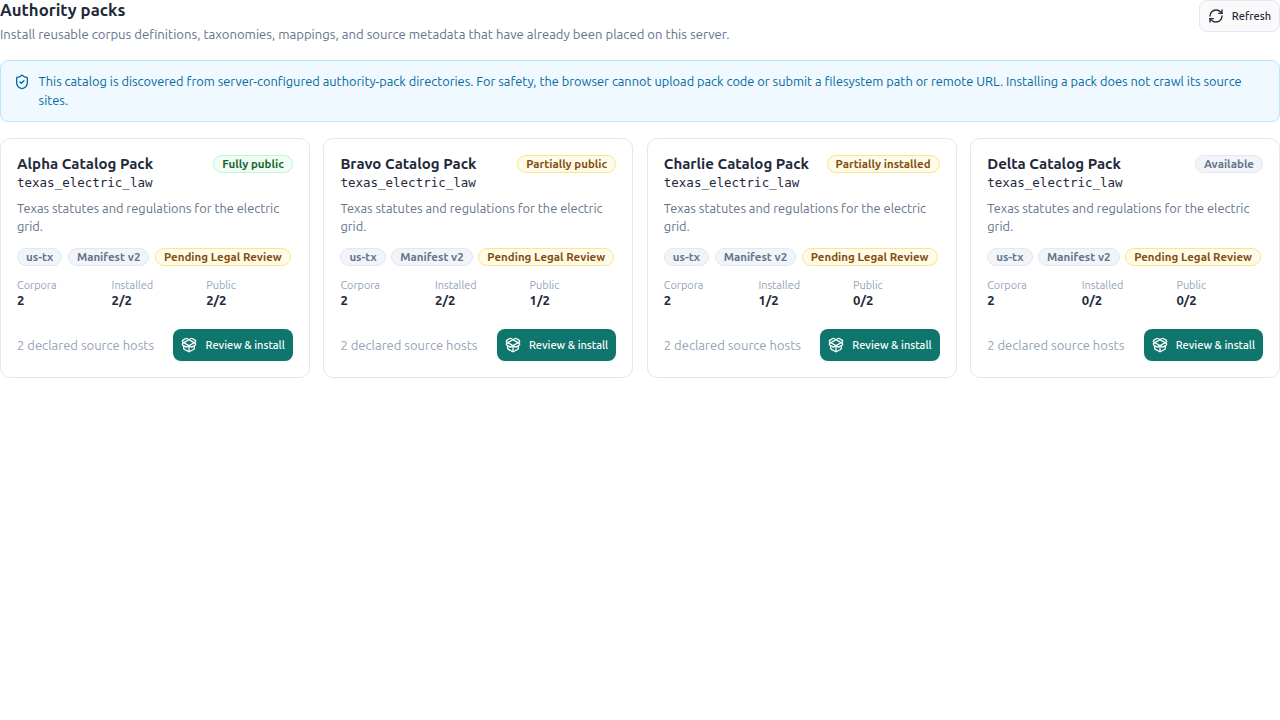
The trusted server catalog is discovered from the shipped pack directory and AUTHORITY_PACK_ROOTS / AUTHORITY_PACK_PATHS (see Installing a sideloaded pack). The browser sends an opaque pack ID, never a filesystem path, URL, archive, or manifest — the catalog is the only way in, so the console cannot be used to upload pack code or point the server at an arbitrary directory.
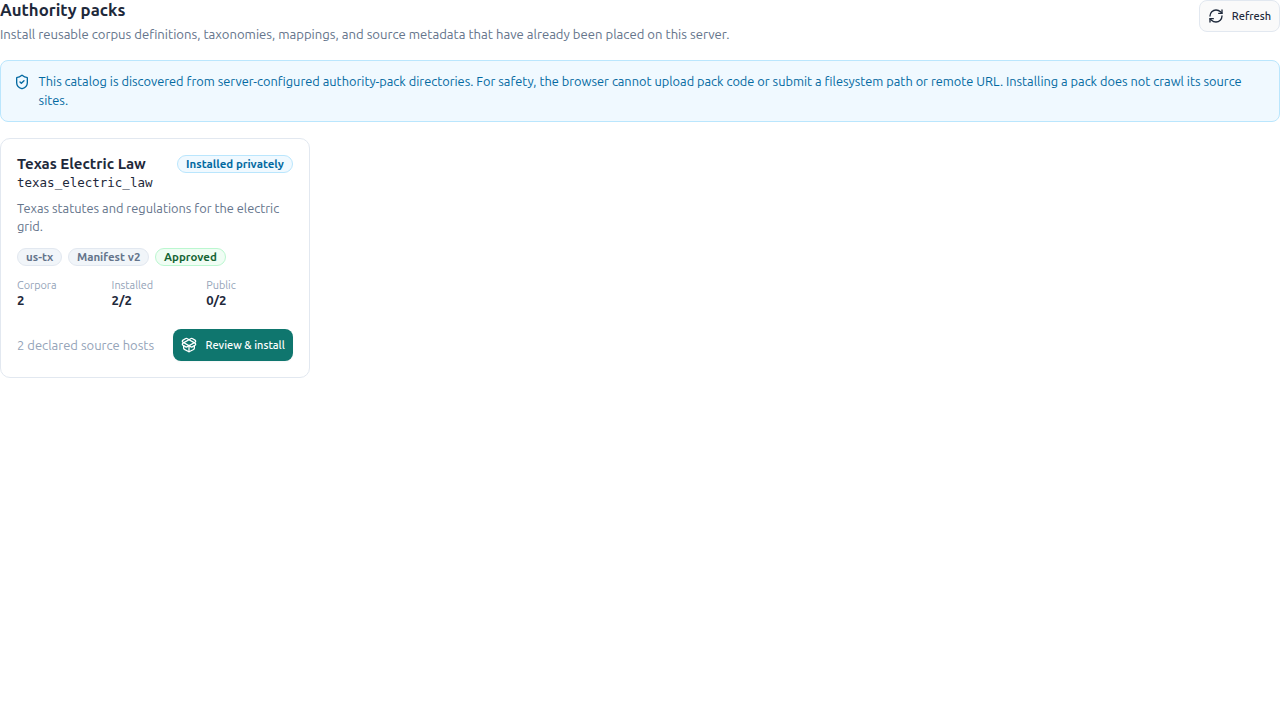
Each card carries the pack's display name over its manifest name, the declared jurisdiction / manifest schema version / charter approval state as chips, Corpora + Installed n/m + Public n/m counts, and its declared source-host count. The status badge (PacksTab.tsx::packStatus) is derived, not stored:
| Badge | Meaning |
|---|---|
Invalid | The manifest failed server validation. The card shows the error, and its button reads Review pack and is disabled ("Repair this server-deployed pack before installing it") — an invalid pack cannot even be opened, since can_install tracks valid exactly. |
Available | Valid, nothing installed yet. |
Partially installed | Some but not all of the pack's corpora exist. |
Installed privately | Every corpus installed, none public. |
Partially public / Fully public | Some / all installed corpora are published. |
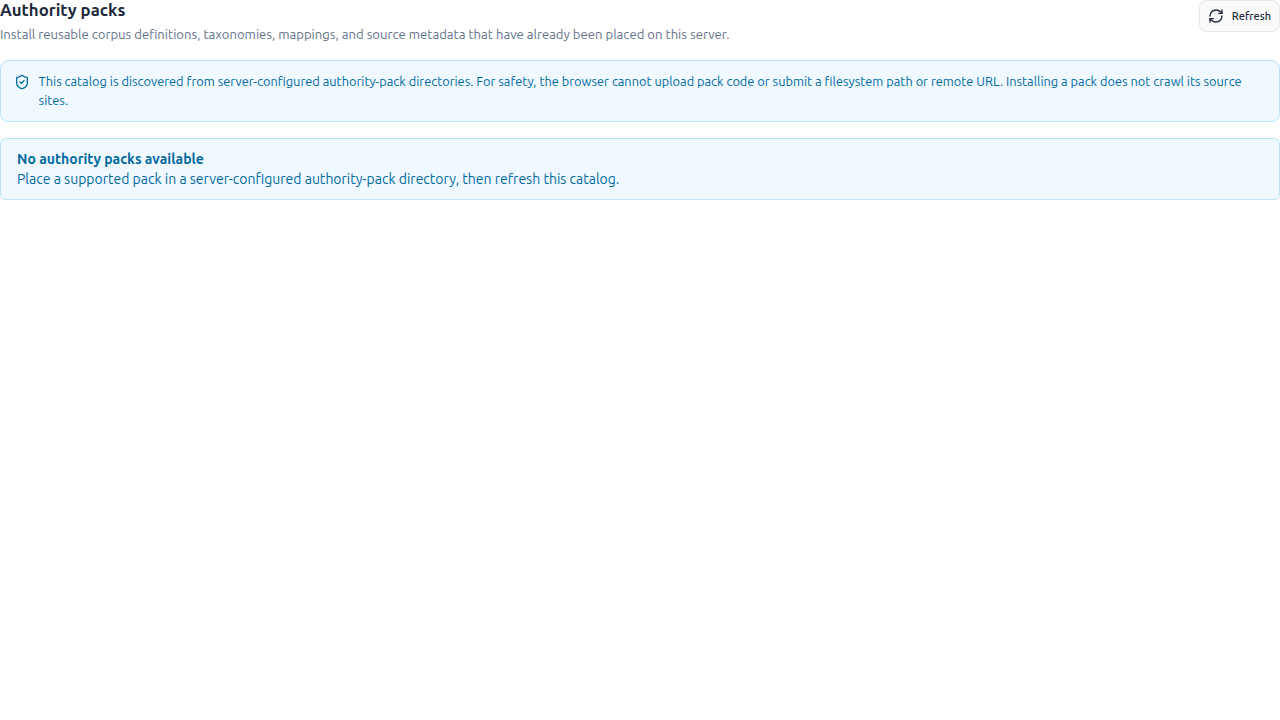
An empty catalog is the normal symptom of an unmounted or mis-pointed pack directory — the pack root is resolved inside the container, so a host path that was never bind-mounted yields exactly this:
Preflight¶
Review & install (the button on any valid pack) runs a fresh, side-effect-free preflight (AuthorityPackService.preflight) and shows what an install would do before anything is written:
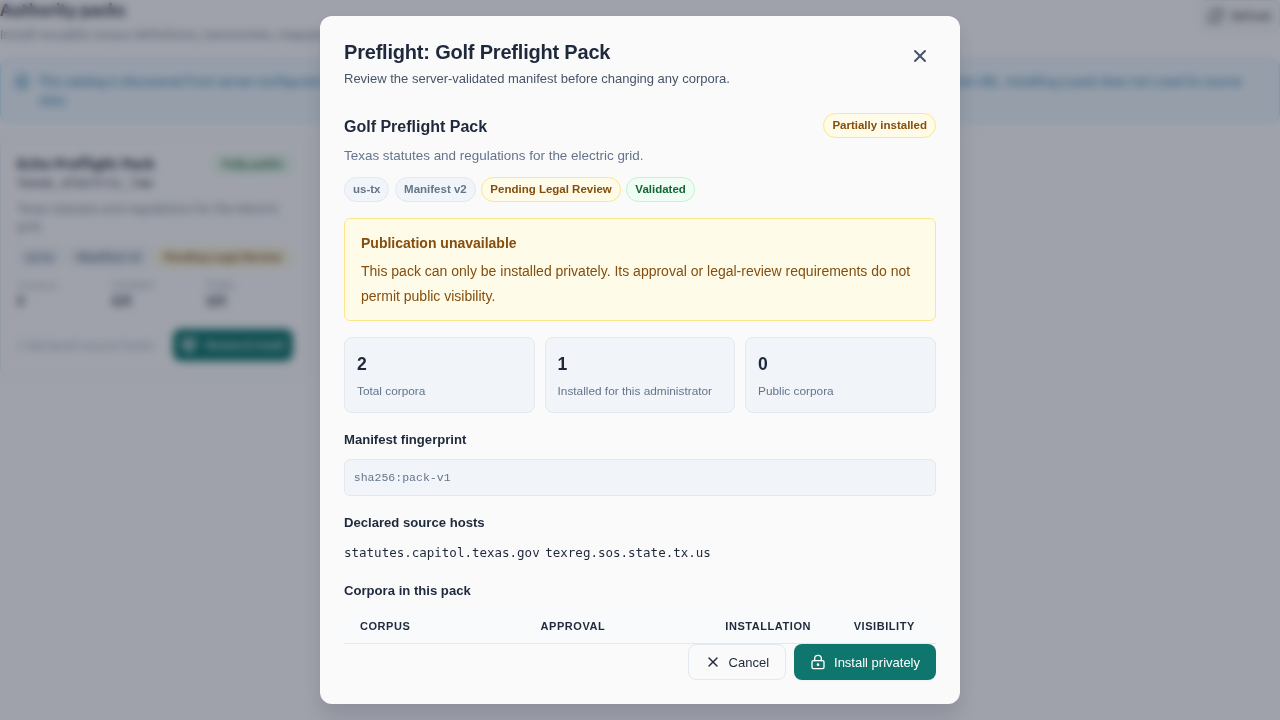
The manifest fingerprint is round-tripped as expectedFingerprint on the install mutation, so a pack edited on disk between preflight and install is rejected rather than silently installing something else. Declared source hosts are listed because installing is the trust decision that widens the SSRF allowlist. The per-corpus table gives each corpus's slug, charter approval, installation state, and visibility.
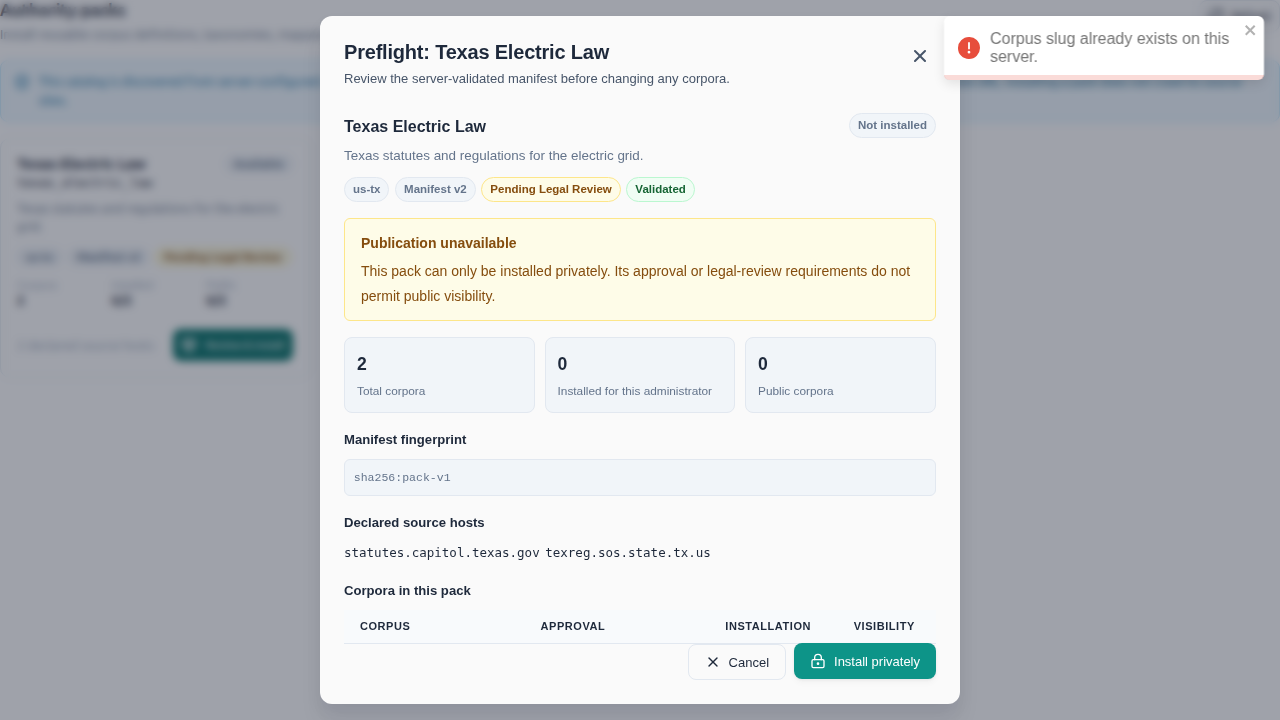
Installation is private by default and atomically reuses the same AuthorityPackService as the operator command. Publish is a separate opt-in checkbox that stays disabled while a declared charter is unapproved or pending_legal_review (the Publication unavailable notice above). The modal refuses to close while an install is in flight, so a half-applied transaction is never left unattended. A server-side rejection is surfaced in place as Installation failed rather than as a toast that scrolls away — a slug already owned by another creator is the common one, and it is refused here rather than producing a second corpus:
The same validation is reachable headlessly — load_authority_pack --check prints the fingerprint, source hosts, approval state, and per-corpus plan and writes nothing, because a headless deployment has no authority-admin browser session.
After a successful install the modal closes and the card flips to its new state — below, a pack installed privately, so both corpora exist but neither is published (Installed 2/2, Public 0/2):
Once a corpus is installed, Import corpus ZIP opens the existing corpus-export modal with that corpus's server-issued ID. Direct and resumable chunked uploads therefore share the normal import service and permission gate; the console does not add a second ingestion system. This is the landing surface for deployments whose acquisition and crawling happen outside OpenContracts — see Collecting content out of process.
Authorities (Registry tab)¶
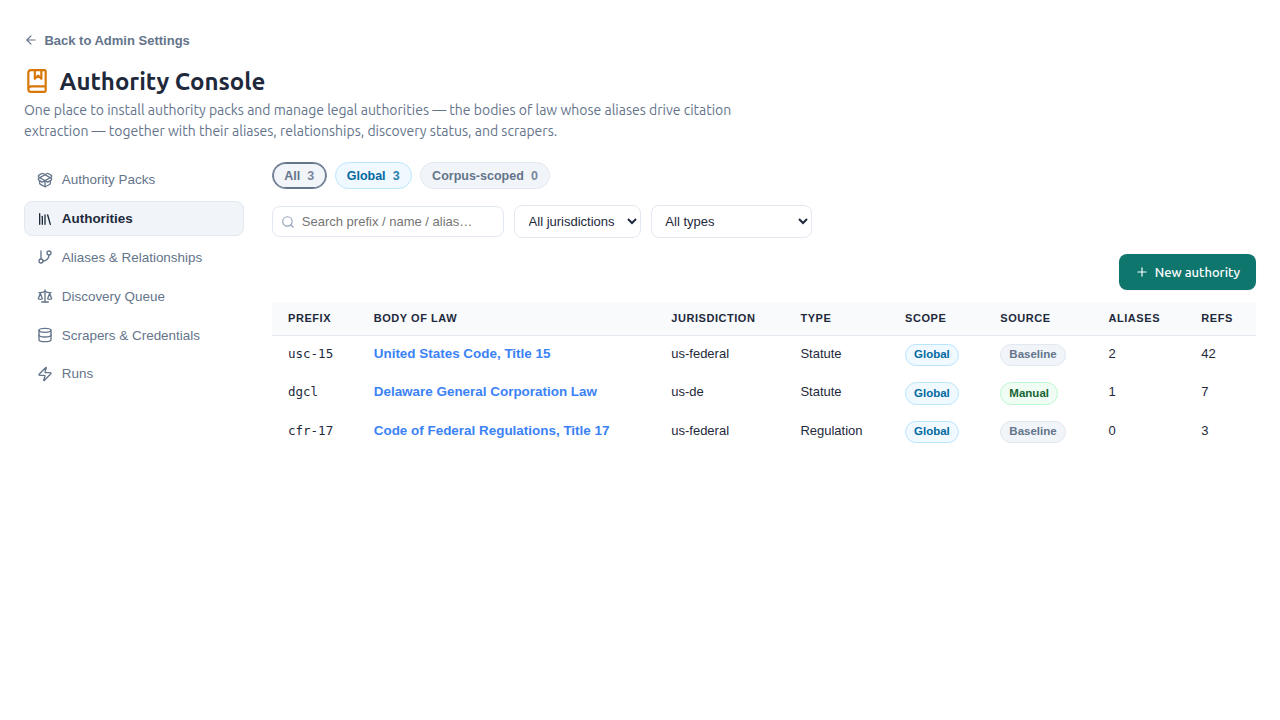
The master list of AuthorityNamespace rows. Faceted scope chips (global / corpus) plus jurisdiction and authority-type selects and free-text search drive the authorityNamespaces relay connection; an inline New authority form creates a row; the table (Prefix / Body of law / Jurisdiction / Type / Scope / Source / Aliases / Refs) links each display name into the detail view. Chip counts come from authorityNamespaceStats, which honours the same search predicate as the list so counts can never desync from rows.
Authority detail¶
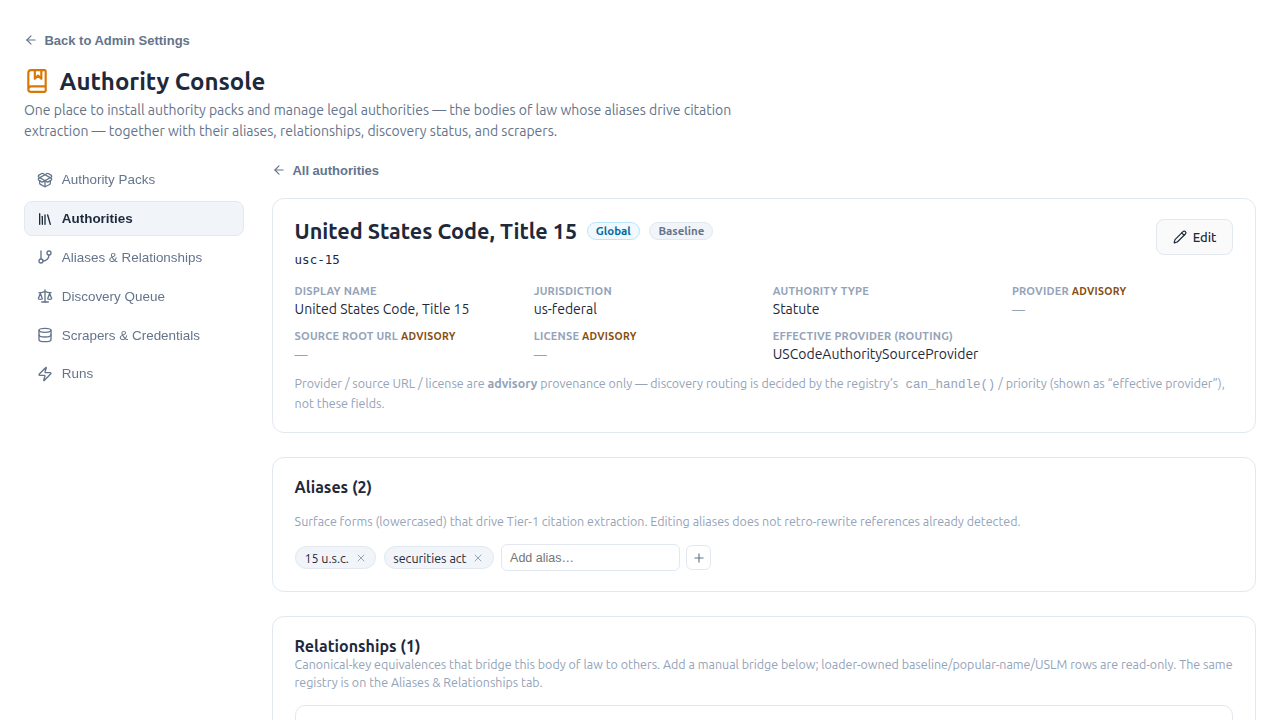
One body of law, assembled by AuthorityNamespaceService.detail() (one authorityNamespaceDetail(prefix) query) via string joins. Sections:
| Section | Editable? | Notes |
|---|---|---|
| Header / metadata | ✅ display name, jurisdiction, authority type | via updateAuthorityNamespace |
| Provider / source URL / license | ✅ but advisory only | routing is decided by the registry's can_handle()/priority; the resolved effective provider is shown alongside |
| Aliases | ✅ | add/remove lowercased chips that drive Tier-1 extraction; editing does not retro-rewrite already-detected references |
| Relationships (key-equivalences) | ✅ manual rows only | shared editor with the Mappings tab; loader-owned baseline/popular-name/USLM rows are read-only |
| Discovery queue | read-only | state-count badges + frontier rows; the row action verbs live in the Queue tab |
| References | read-only by design | machine-populated; total + per-status counts only |
| Danger zone | delete | allowed only when no equivalence / frontier / reference row still references the prefix |
Aliases & Relationships (Mappings tab)¶
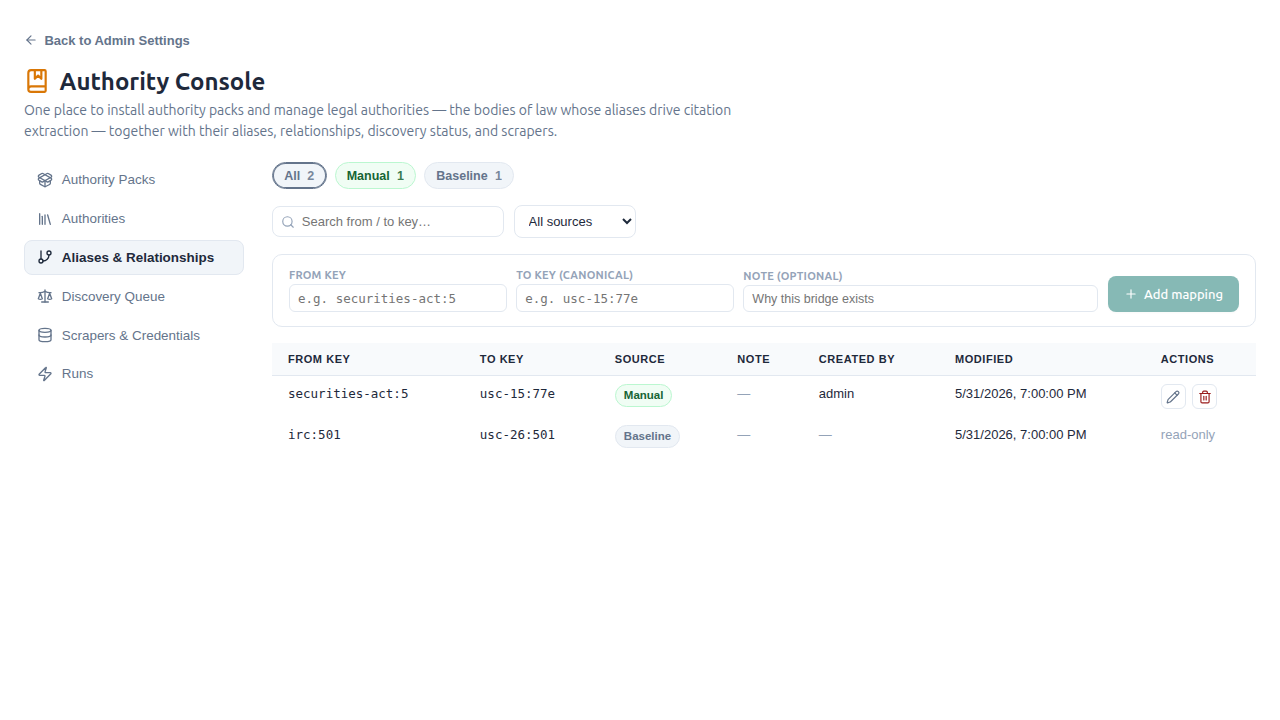
The AuthorityKeyEquivalence registry (e.g. act-section ↔ USC/CFR canonical-key bridges). Source chips + source filter + search over authorityKeyEquivalences, an inline create form, and per-row edit/delete via the shared KeyEquivalenceEditor (reused by the detail view's Relationships section). Manual rows are editable; loader-owned rows are read-only.
Discovery Queue tab¶
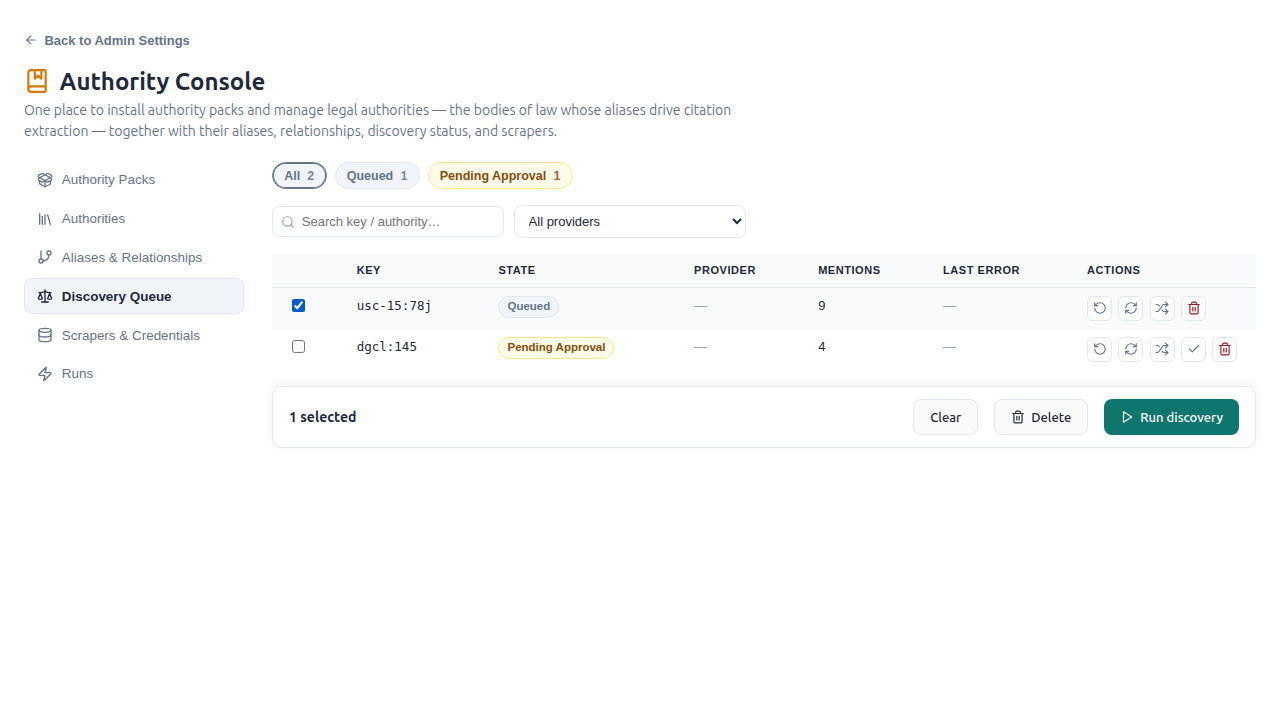
The instance-wide AuthorityFrontier crawl/ingestion backlog. State chips + provider/jurisdiction/type facets + search over authorityFrontier, checkbox multi-select with a sticky action bar (Run discovery / delete), and — new in the console — per-row requeue / reset / reroute / approve / delete verbs. Reroute is constrained client-side to the registered provider class names from authoritySourceProviders.
Scrapers & Credentials tab¶
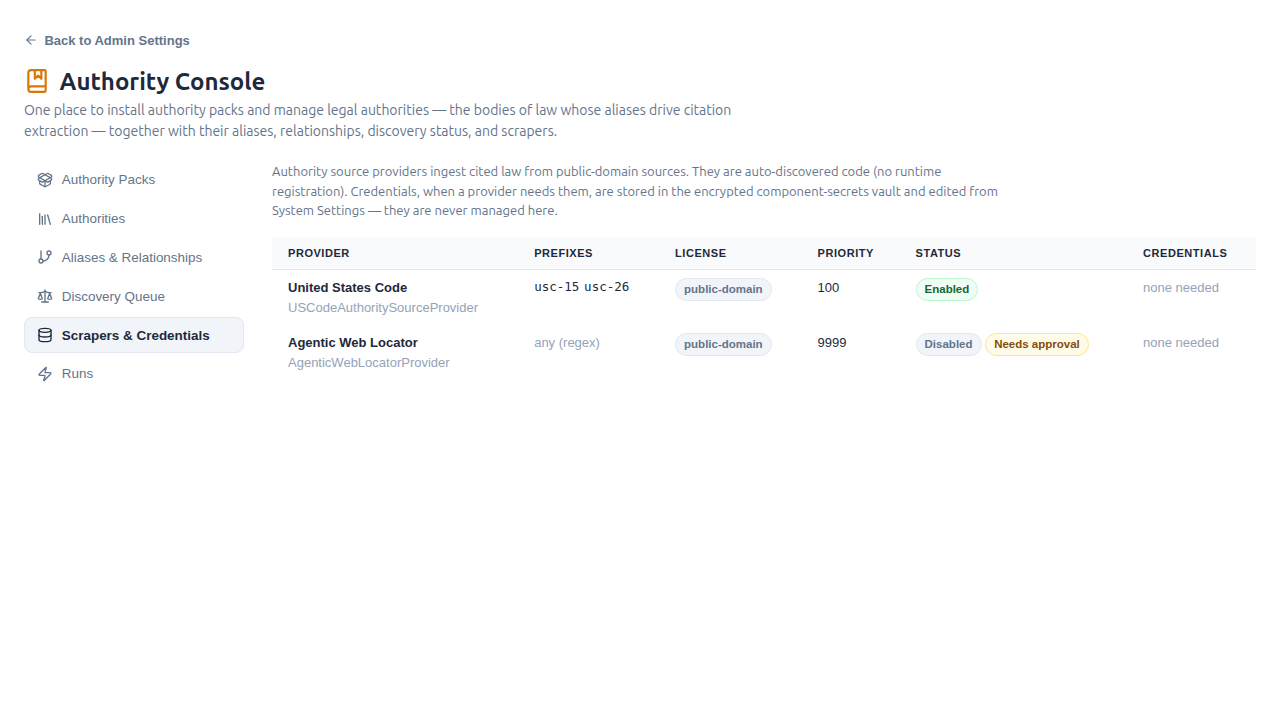
A read-only view of the registered source providers (US Code / eCFR / Federal Register / agentic web locator) from authoritySourceProviders: supported prefixes, license, priority, the enabled and requires-approval flags, and whether the secrets vault holds credentials. Enabling/disabling stays in code; credentials are edited through System Settings' component-secrets vault (updateComponentSecrets), not here — the console never invents a parallel credential store. Providers can be shipped inside an authority pack (<pack>/providers/) so a scraper travels with its jurisdiction — see Authoring an Authority Pack.
Runs tab¶
Dispatch reference-enrichment / authority-discovery analyses on a corpus and review job status. The corpus picker, EnrichmentRunner, and EnrichmentJobList are re-mounted unchanged from components/admin/enrichment/ (they also back the per-corpus CorpusEnrichmentCard, which is why they stay in that directory rather than moving under authority/).
AuthorityNamespace — the spine¶
AuthorityNamespace (opencontractserver/annotations/models.py) is the registry of bodies of law whose aliases drive Tier-1 citation extraction. Two fields added for the console give it runtime ownership semantics:
source(baseline|manual) — an ownership marker mirroringAuthorityKeyEquivalence.source. The loader (AuthorityMappingLoader.load_namespaces) owns onlybaselinerows: it upserts YAML prefixes asbaselineand skips anymanualrow (alongside its existing skip of corpus-linked rows). Every row created or edited through the console is stampedmanual, so a YAML re-load can no longer silently clobber a curator's runtime edits — a real bug the previous loader had (itupdate_or_created every global prefix).created_by— provenance for who curated the row (SET_NULL; null for loader-owned baseline rows).
Because there are no foreign keys between the authority models, the single-authority projection joins by string key. The join is colon-anchored on "<prefix>:" (e.g. usc-1:), never the bare prefix — so usc-1 never swallows usc-15.
Services & the is_authority_admin gate¶
All access routes through opencontractserver/enrichment/services/ (per the service-layer invariant; the GraphQL surface is E001-clean).
AuthorityNamespaceService — the runtime CRUD + read peer to AuthorityKeyEquivalenceService (extends BaseService):
| Method | Behaviour |
|---|---|
visible(user) | all rows for an admin, else .none() — the queryset-gate peer to the node's get_queryset, which inlines the same is_authority_admin check |
stats(user, search) | faceted counts (by_jurisdiction / by_authority_type / by_scope); honours search but not the facet selects |
detail(user, prefix) | the string-join projection (aliases + in/out equivalences + frontier rows + reference counts + effective provider); None for non-admins or unknown prefix (opaque) |
create(...) | validates the prefix grammar, normalizes aliases, stamps source="manual" + created_by; surfaces the is_global⊕authority_corpus ValidationError as a clean error |
update(pk, **partial) | partial edit; always re-stamps source="manual" so the curator override wins over the shipped baseline |
set_aliases(pk, aliases) | the one alias writer (lowercase + de-dupe + sort) — delegates to update |
delete(pk) | refuses with a count-bearing error if any equivalence / frontier / reference row still references the prefix, so a delete never orphans dependents |
AuthoritySourceProviderService.list_providers(user) — read-only projection of the auto-discovered provider classes, with has_credentials derived from the existing PipelineSettings encrypted-secrets vault (degrades to "no credentials" if the vault read fails rather than breaking the listing).
AuthorityFrontierService — the discovery-queue action verbs, each a thin wrapper over the single transition primitive mark():
| Verb | Effect |
|---|---|
requeue(pk) | → queued, clears ingested_document + last_error (un-sticks deferred_cap/failed) |
reset(pk) | → queued, clears document + provider + error |
reroute(pk, provider) | validates provider against the registry, sets it, → queued, clears document + error |
approve(pk) | pending_approval → queued (clears error only) |
delete_rows(pks) | guarded bulk delete |
mark() gained explicit clear_document / clear_error / clear_provider / set_provider kwargs so it stays the single writer of frontier state. Clearing ingested_document on requeue is mandatory: the frontier_queued_no_ingested_doc check constraint forbids a queued row that still carries a document. The re-queueing verbs refuse a row that is in_progress (a worker is actively ingesting it).
The gate. is_authority_admin(user) (opencontractserver/enrichment/services/authority_permissions.py) is the one authority-admin gate — bool(user and user.is_authenticated and user.is_superuser) today, with the single future seam (a law_librarian group/flag) living here and nowhere else. Authority data is system-wide with no per-object permissions, so it cannot use the corpus/document guardian model. The companion DENIED constant ("Resource not found or you do not have permission.") is returned identically whether a row is missing or the caller lacks access, so the superuser-only surface is no existence oracle. The gate is threaded through every authority service method, every authority node's get_queryset, and every authority mutation — consolidating the per-surface inline user.is_superuser checks that existed before.
GraphQL surface¶
All in config/graphql/ (queries in annotation_queries.py, types in annotation_types.py, filter in filters.py):
- Queries (superuser-only):
authorityNamespaces(filtered relay connection),authorityNamespaceStats,authorityNamespaceDetail(prefix),authoritySourceProviders. - Mutations (
@login_required+ superuser via the service):create/update/setAliases/deleteAuthorityNamespace(authority_namespace_mutations.py);requeue/reset/reroute/approve/deleteAuthorityFrontier(authority_frontier_mutations.py). - The choice-bearing fields
sourceandauthority_typeare declared as rawgraphene.String(not auto-enums) and the filter uses StringCharFilters, so the faceted chip values feed straight back into the list filter.
Migrations¶
- 0099 — adds
AuthorityNamespace.source(baseline/manual, indexed, defaultbaseline) andcreated_by. - 0100 — retires the dead
AuthorityFrontier.discovery_statevaluesdiscoveredandresolved(choices-onlyAlterField, no data migration). No production path ever assigned them — discovery goesin_progress → ingested, and the resolution outcome lives on the relink result /Analysis, not the frontier row.
Permissions¶
The whole console is superuser-only, enforced server-side at the node get_queryset and service layer (not merely hidden in the UI). useIsAuthorityAdmin gates the frontend the same way, using the wait-on-null pattern so an admin never sees an "Access Denied" flash mid-load. Note this differs from the enrichment runs themselves: runCorpusEnrichment is gated on corpus UPDATE (with the superuser READ-trigger exemption) — see Reference-Web Enrichment § Permissions.
Design notes¶
The chosen architecture (an AuthorityNamespace-pivot home + cross-cutting sibling tabs) won out over a "graph-is-the-console" alternative: the instance-wide editable graph was judged risk-inverting eye-candy, and the namespace pivot matches the data model — every cross-model link is a string join on the prefix, so the registry is the join root. The interactive graph is demoted to an optional, deferrable detail lens (not built here); the corpus-scoped GovernanceGraphExplorer remains the place to explore the citation graph.
Five decisions were settled during design and carried into the implementation:
- References stay strictly read-only. They are machine-populated and would be clobbered by the next relink; no
SetCorpusReferenceCanonicalKeymutation exists. (Revisit only behind a persistedis_manual_overrideflag if demanded.) mark()is extended, not bypassed. The action verbs clear fields via newclear_*kwargs onmark()rather than writing frontier fields outside it, so it remains the literal single writer of discovery state.- Dead states are retired, not wired.
discovered/resolvedwere removed from the choices (migration 0100) rather than plumbed through the async relink seam, which would have added race surface for no behavioural gain. - Advisory provider columns stay editable but clearly advisory. Admins can record
provider/source_root_url/licenseas provenance metadata, but routing stays registry-driven; the resolved effective provider is shown beside them. - Old routes redirect for one release. The three deleted paths render client-side
<Navigate replace>redirects into the new tabs (SPA redirects, not HTTP 301s), then can be removed.
Known limitations & follow-ups¶
- Detail-view frontier actions. The authority detail's Discovery-queue section is read-only; the per-row verbs are available in the Queue tab. Wiring them into the detail is an optional nicety.
- Graph lens (deferred). An authority-only
?lens=graphprojection on the detail view, reusingutils/governanceGraphLayout.ts, was designed but not built. - Filtered-state screenshot. A console-tab screenshot of the queue filtered to a single state is not yet captured; regenerate via the screenshot workflow when needed.