Reference-Web Enrichment & Authority Discovery¶
Overview¶
Enrichment turns a corpus of documents into a reference web: it detects every explicit legal citation, cross-reference, and exhibit link in the text, resolves each to a target (another document, an internal section, or an external body of law), and persists the result as CorpusReference rows plus the DocumentRelationship edges the governance graph renders.
Authority discovery is the recursive follow-on: the citations a corpus makes to laws it does not contain (the "wanted authorities") seed a global AuthorityFrontier queue, and a bounded crawl ingests those statutes/regulations from public-domain providers so the citations resolve from EXTERNAL to RESOLVED.
What a reader ends up with is the document's References panel — every tag the engine produced, in both directions:
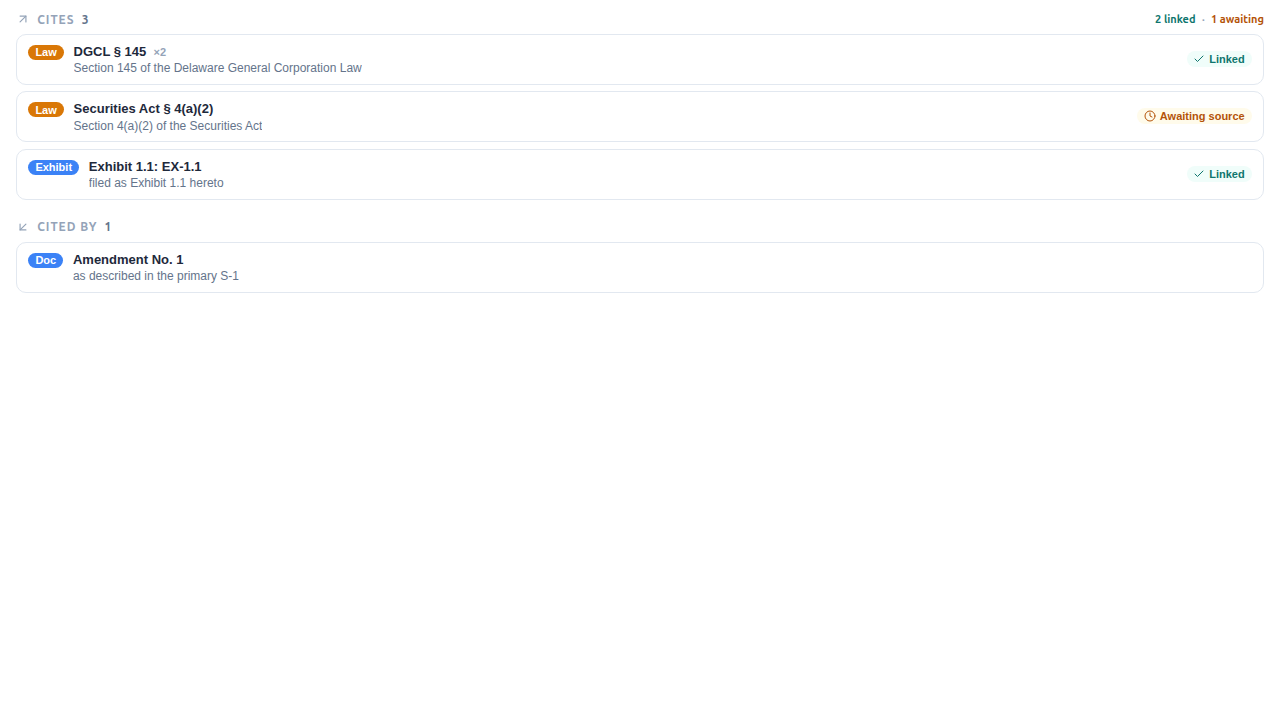
Under CITES, each row is one CorpusReference — chipped by what it points at (Law, Exhibit), counted by mentions (×2 where the same authority is cited twice), and badged with where it landed. Linked means the target is in reach and the row opens it; Awaiting source is the interesting one — an unresolved LAW reference, a statute this corpus cites but does not contain. Those rows are the wanted authorities that seed the crawl, which is what makes the panel read as a to-do list rather than a list of failures. CITED BY is the same web read backwards, from the DocumentRelationship projection.
This document covers the detection engine, the in-flight persistence lifecycle, the cross-document concurrency model, the authority crawl, and how to operate all of it (trigger, monitor, explore). It assumes the reader is comfortable with the Django/Celery backend.
Related - Design specs:
docs/superpowers/specs/2026-06-16-corpus-enrichment-runner-design.md,docs/superpowers/specs/2026-06-17-in-flight-authority-detection-design.md,docs/superpowers/specs/2026-06-17-global-authority-sources-view-design.md- Manual procedure:docs/test_scripts/corpus_reference_enrichment.md- Versioning gap:docs/architecture/reference-web-versioning.md
The detection tiers¶
Detection is additive: the trusted registry tier is always the base, and extra_tiers selects which additional layers merge on top of it. The tiers are stamped on each CorpusReference.detection_tier:
| Tier | Component | What it finds | Cost |
|---|---|---|---|
registry | ReferenceExtractor + authority_alias_registry | Known authorities by curated alias (DGCL, USC, CFR, the Securities/Exchange Acts, …) | Instant |
grammar | GenericCitationExtractor | Open-vocabulary "… Act / § …" citation shapes the registry doesn't know | Instant |
llm (Tier-2b) | LLMCitationExtractor | The long tail a grammar can't express — pinpoint statute sections, international law, accounting standards, etc. | Slow, opt-in (use_llm=True), external provider calls |
On a real S-1 corpus the LLM tier surfaces authorities no grammar reaches — ERISA sections, EU Prospectus Regulation sub-articles, UK FSMA, DOL prohibited-transaction exemptions, accounting standards (ASC/ASU), tax (IRC/Treasury Reg) — alongside the registry/grammar hits.
reconcile() merges the tiers with a clear precedence: the registry wins on span overlap, and grammar/LLM candidates add only the non-overlapping tail. So a citation the grammar already catches is never also stored as a (lower-trust) LLM row.
Where a jurisdiction's vocabulary comes from. The registry tier reads AuthorityNamespace prefixes and aliases, which are curated through the Authority Console Registry tab and loaded in bulk from the shipped authority_mappings.yaml baseline plus every installed authority pack. A pack also carries optional shape_rules (classify a numbered prefix family) and abbreviations (Bluebook-style forms the Tier-2a extractor matches), merged onto the shipped baseline at runtime — so standing up detection for a new body of law is a data change, not a code change. See Authoring an Authority Pack.
Customs / trade grammar family (CBP CROSS-style corpora)¶
The grammar tier also ships two deterministic customs families (opencontractserver/enrichment/grammars.py::_hts / ::_document_identifier_citations; shapes ported from crossfeed's golden-tested CROSS extractor). Because they are ordinary grammar-tier candidates, they run automatically wherever enrichment already runs — the analyzer task, the ADD_DOCUMENT corpus action installed by setupCorpusIntelligence / ingest_corpus --enrich, the runCorpusEnrichment mutation, and the agent tools. There is no separate service or management command.
- HTS tariff codes →
REF_LAWcitations keyedhtsus:<code>(constants.HTSUS_PREFIX; prefix declared inauthority_mappings.yaml). Gated on a document-level HTSUS cue so dotted decimals in ordinary corpora are never mined; per-mention confidence distinguishes tariff-cue-anchored codes from bare contextual ones. - Identifier document citations (CBP ruling numbers, both the prefixed modern shape
H022844and the legacy series-token formHQ 084665/HRL 087392—constants.LEGACY_DOC_IDENTIFIER_CITE_RE) →REF_DOCUMENTcitations resolved byReferenceResolveragainst sibling document identities. Identity derivation (opencontractserver/enrichment/resolver.py::document_identity_candidates) is layered, highest-priority first: a durableDocumentPath.external_idin thecross:namespace (survives renames; populated by the ZIP import'smeta.csvexternal_idcolumn), then the active corpus path's basename stem, then the display title's stem (extension-stripped viaconstants.document_identifier_from_title, so materialized-filename titles likeA83482.docstill resolve). The grammar only activates on corpora whose document identities are predominantly identifier-shaped (constants.DOC_IDENTIFIER_TITLE_GATE_*); self-mentions (a ruling's own header) are dropped at resolution, and duplicate document identities resolveUNRESOLVEDwith a warning rather than guessing a target. Citations to rulings not yet in the corpus persistUNRESOLVEDand are healed toRESOLVEDby the writer when the sibling lands and enrichment re-applies — which the ADD_DOCUMENT corpus action does automatically.
The enrichment pipeline¶
EnrichmentService (opencontractserver/enrichment/services/enrichment_service.py) is the single entry point:
scan— extract + resolve across the corpus, return an inventory, no writes.discover— read-only open-vocabulary inventory grouped by jurisdiction / authority type, flagging prefixes with noAuthorityNamespacerow (genuinely new bodies of law).apply— scan, then persist under anAnalysis(the durable run).
For each document apply runs: detect (registry + grammar + optional LLM) → resolve (ReferenceResolver maps each candidate to a target + a resolution_status) → write (EnrichmentWriter materialises annotations, within-document Relationships, and CorpusReference rows; resolved doc→doc references roll up once into the DocumentRelationship projection the graph renders).
The Celery surface is the @corpus_analyzer_task-decorated corpus_reference_enrichment task, which owns the Analysis lifecycle (RUNNING → COMPLETED/FAILED). Crucially, the decorator does not wrap the task body in a transaction — which is what makes the per-document writes below commit independently and become visible mid-run.
In-flight persistence & the provisional lifecycle¶
Historically apply did one bulk write at the very end of a run. For the slow LLM tier that meant nothing was queryable for the whole pass, and a worker restart at minute N lost all N minutes of work (observed: a 72-minute run orphaned at RUNNING with zero rows written).
Enrichment now persists incrementally. Each CorpusReference carries is_provisional (BooleanField, default False — migration annotations/0090_corpusreference_is_provisional, schema-only so every pre-existing row is already finalized):
- Stream.
applywrites each document's references the moment that document's detection completes, markedis_provisional=True, in its own committed transaction — so the References panel, governance graph, and/admin/authority/queuefill during the run. - Finalize. On success the run flips its own rows finalized in one atomic update keyed on
created_by_analysis:CorpusReference.objects.filter(created_by_analysis=run, is_provisional=True).update(is_provisional=False). - Resilience (claim rule). A run that dies mid-flight leaves its rows provisional. The writer's claim rule (
EnrichmentWriter._ensure_corpus_reference) re-attributes any still-provisional row it re-touches to the current run — regardless of whether the prior owner FAILED or is stuck RUNNING — so the next successful run reclaims and finalizes orphaned rows with no reaper required. A finalized row is never downgraded, even mid-re-run.
Show provisional, act on finalized. Display surfaces (References panel, governance graph, the authorities monitor) render in-flight rows so progress is visible. Irreversible work acts on finalized rows only: the crawl seed pulls
CorpusReferenceService.wanted_authorities(finalized_only=True), so a half-finished run can never trigger an authority ingest.isProvisionalis exposed onCorpusReferenceTypefor the frontend.
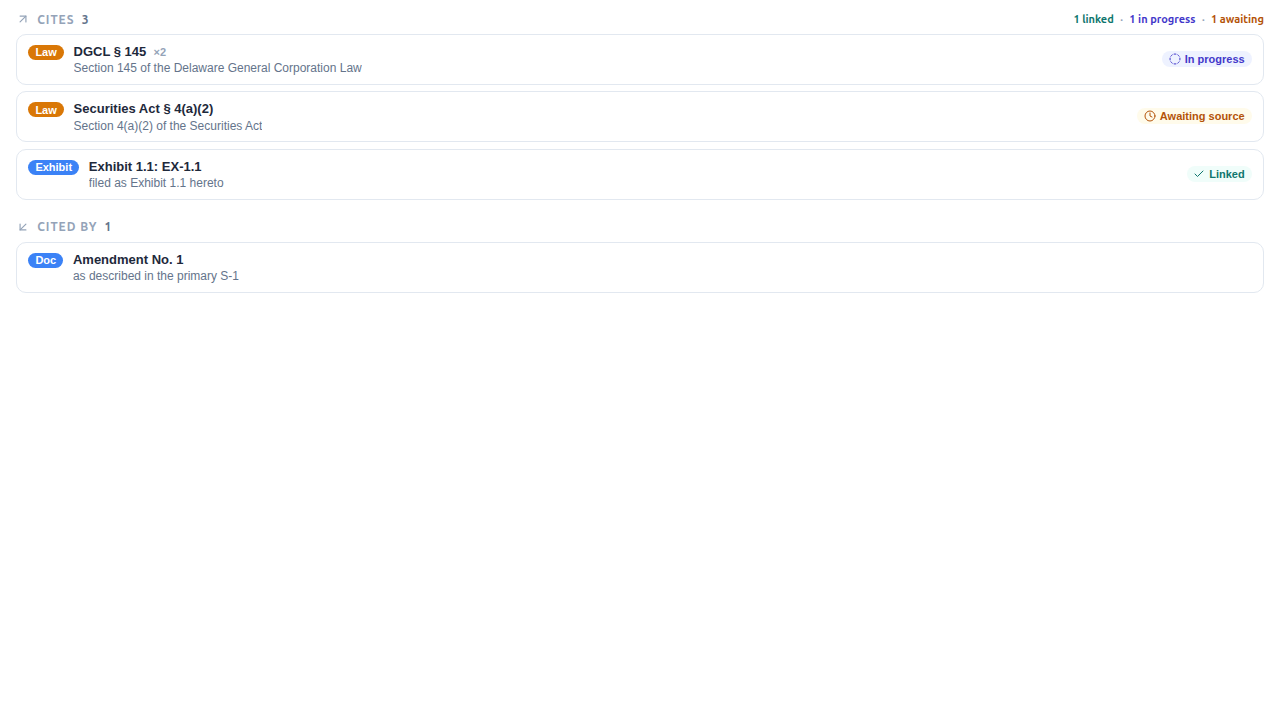
The document References panel badges in-flight references In progress (taking precedence over their preliminary Linked / Awaiting state) until the run finalizes:
Cross-document LLM concurrency¶
The LLM tier was originally strictly serial — every ~2,000-char window of every document was a sequential await (one corpus measured ~2,900 serial calls). Two changes make it concurrent while preserving the incremental writes above:
- Within a document,
LLMCitationExtractor.aextract(opencontractserver/enrichment/llm_citation_extractor.py) enumerates its sliding-window chunks and runs them throughasyncio.gatherbehind a semaphore. The window grew from 2,000 → 8,000 chars (≈4× fewer chunks, ~5% overlap instead of 20%). Chunk results are processed in input order so the "first chunk wins" dedup stays deterministic. - Across documents,
EnrichmentService._aresolve_documentsextracts all documents concurrently under one shared global chunk-semaphore (LLM_MAX_CONCURRENCY, default 8) — so total in-flight provider load stays bounded no matter how many documents are in flight, while the lanes stay full (the per-document path under-utilised them whenever a corpus had a few large documents). Each document is still written the instant its detection completes.
DB writes are marshaled through sync_to_async (thread-sensitive → one shared thread), so the ORM writes serialise and never race; only the LLM calls run concurrently. apply selects this path automatically when the LLM tier is active and keeps the simple synchronous streaming loop for the fast tiers.
Measured on a 75-document / 4.5 MB S-1 corpus: ~72 min (and the run died) → ~4 min, completing with all references finalized.
Tuning. The global cap defaults to a conservative
LLM_MAX_CONCURRENCY(8); raise it via theENRICHMENT_LLM_MAX_CONCURRENCYenv var / Django setting (no code change) to push toward ~2–3 min, at the cost of higher provider rate-limit / cost exposure.
Authority discovery & the crawl frontier¶
EXTERNAL law references are the corpus's wanted authorities — laws it cites but does not contain. AuthorityFrontierService.seed_from_wanted_authorities rolls them up to section roots and upserts one AuthorityFrontier row per root (the instance-wide, system-managed discovery queue). crawl_authorities then drives a bounded BFS: dequeue by demand, pick a public-domain provider, fetch + gate-verify, bootstrap an authority corpus, relink the citations, and seed the ingested authority's own outbound citations at depth+1.
Each frontier row carries a discovery_state:
queued · in_progress · ingested · failed · unsupported · blocked_license · unlocated · pending_approval · deferred_cap
Two pieces worth calling out:
- Provider selection + the namespace bridge.
AuthorityDiscoveryService._provider_forpicks a provider bycan_handle. Providers only handle positive-law keys (usc-*,cfr-*,fedreg), but filings cite popular-name domain keys (exchange-act:10). Rather than mark thoseunsupported,_provider_forresolves a provider-supportedAuthorityKeyEquivalencecounterpart (exchange-act:10 → usc-15:78j) and fetches under that; the post-ingest relink then upgrades the original popular-name references. - The gate.
AuthorityGateServiceenforces verification + license + source domain before anything is ingested (agentic providers can require approval).
Operating it¶
Step-by-step how-to: for runnable procedures — ingesting a supported source (shell, crawl, or the Runs tab) and adding a new provider to flip an authority from
unsupportedto supported — see Ingesting Authorities & Adding Providers. The admin surfaces named below are tabs of the Authority Console at/admin/authority.
Trigger — the Runs tab¶
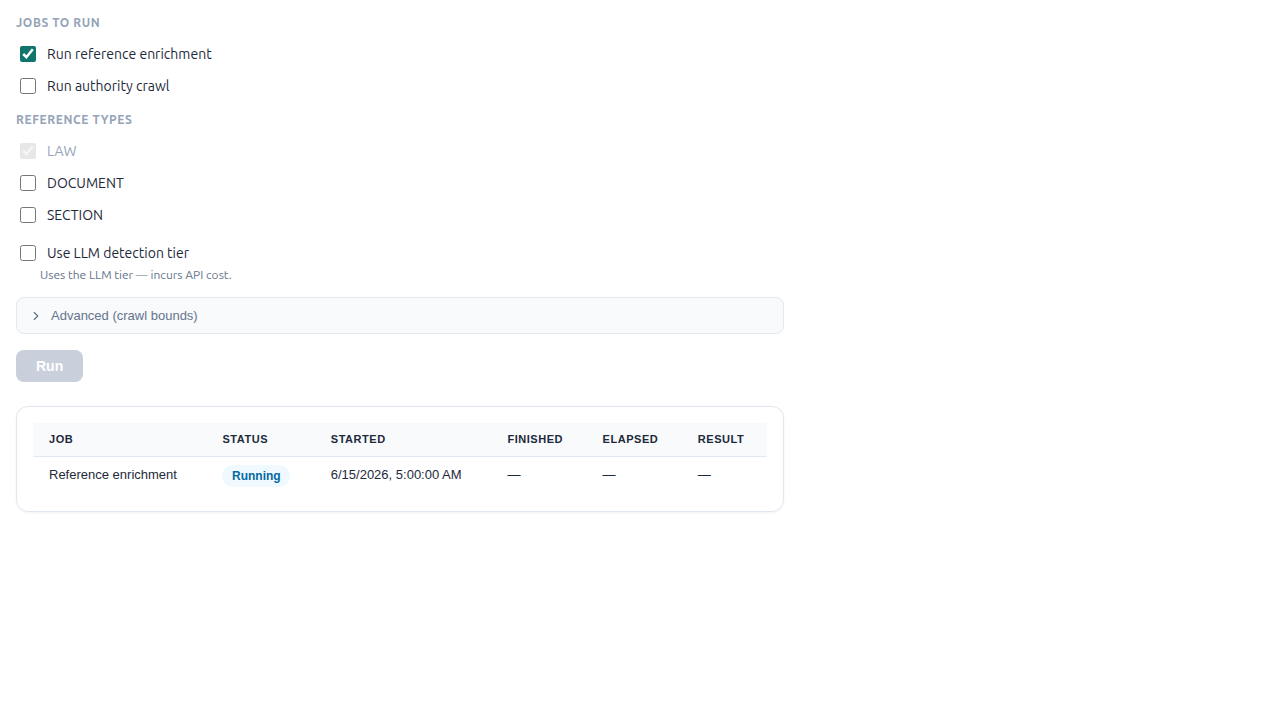
/admin/authority/runs (the Runs tab of the Authority Console, and a per-corpus card) drives runs via the runCorpusEnrichment mutation. Pick reference enrichment and/or authority crawl, optionally enable the LLM detection tier and the advanced crawl bounds (max depth, min demand, max authorities, per-jurisdiction cap, token budget), and Run. The mutation is gated on corpus UPDATE (see Permissions below).
Monitor — live job status & the Queue tab¶
The Runs tab's job list shows each Analysis live (RUNNING / COMPLETED / FAILED, elapsed, result summary) via an Analysis → Notification signal over the notification WebSocket.
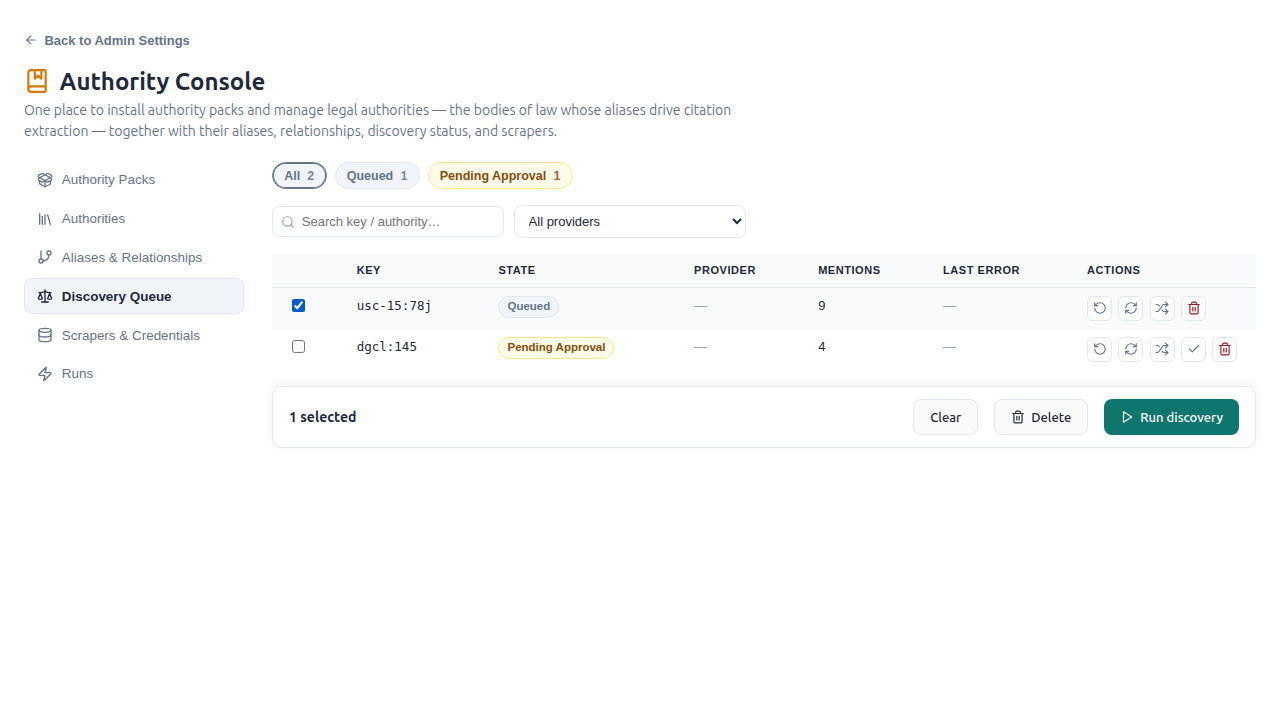
For the instance-wide picture, the Queue tab of the Authority Console at /admin/authority/queue (superuser-only) is the ingestion backlog over the whole AuthorityFrontier: per-state count chips, jurisdiction / type / provider filters, search, and a backlog-first table. It is powered by the authorityFrontier relay connection + authorityFrontierStats (both superuser-gated) and AuthorityFrontierService.admin_state_counts. Beyond observing, it exposes per-row requeue / reset / reroute / approve / delete verbs; triggering enrichment runs stays on the Runs tab.
Explore — the governance graph¶
Every corpus landing page shows a static governance-graph glimpse — the whole reference web of a corpus in one frame, filings above and the law shelf below:
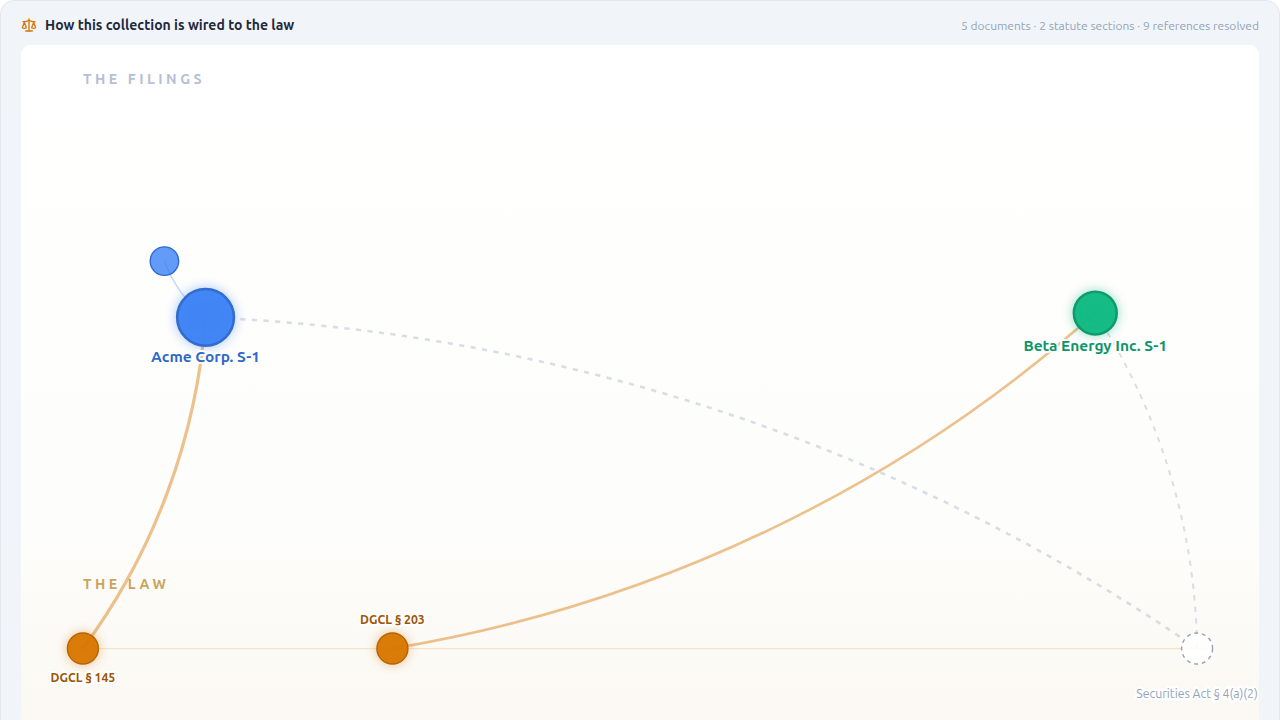
The hollow, dashed node is the same story the References panel tells in list form: a statute the corpus cites but has not ingested. Solid law nodes are resolved; the ghost is a wanted authority waiting on the crawl.
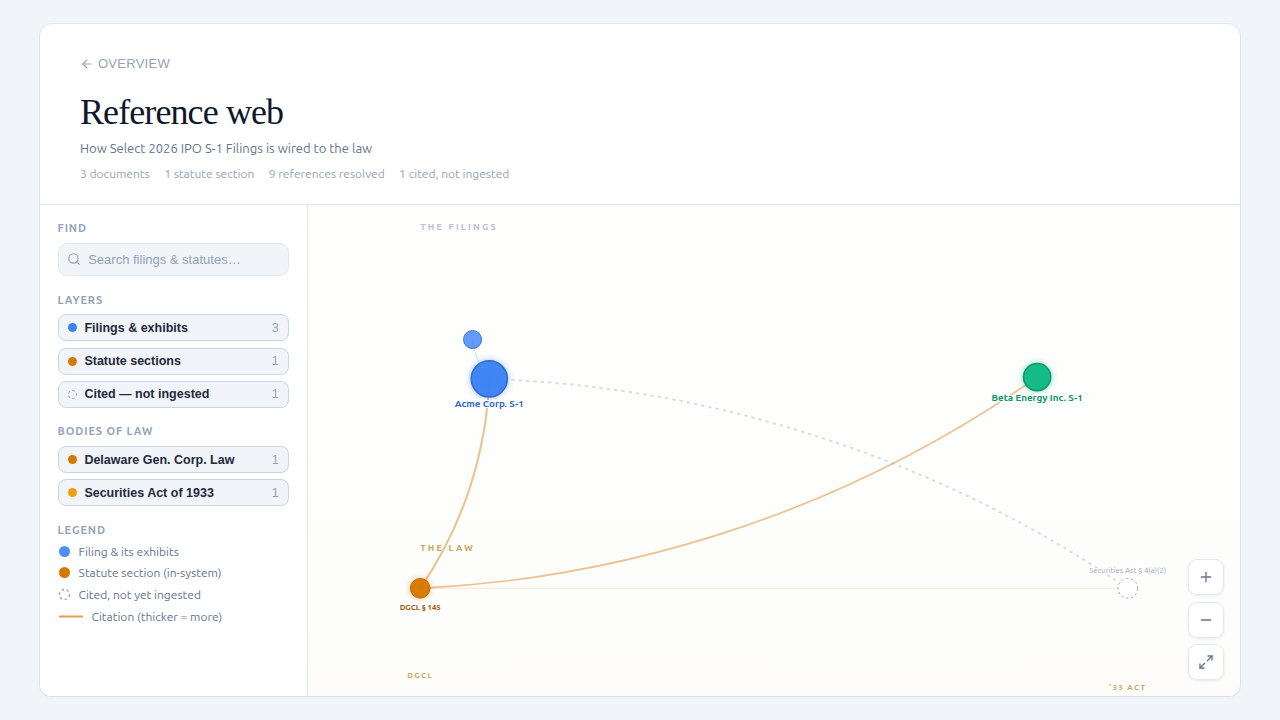
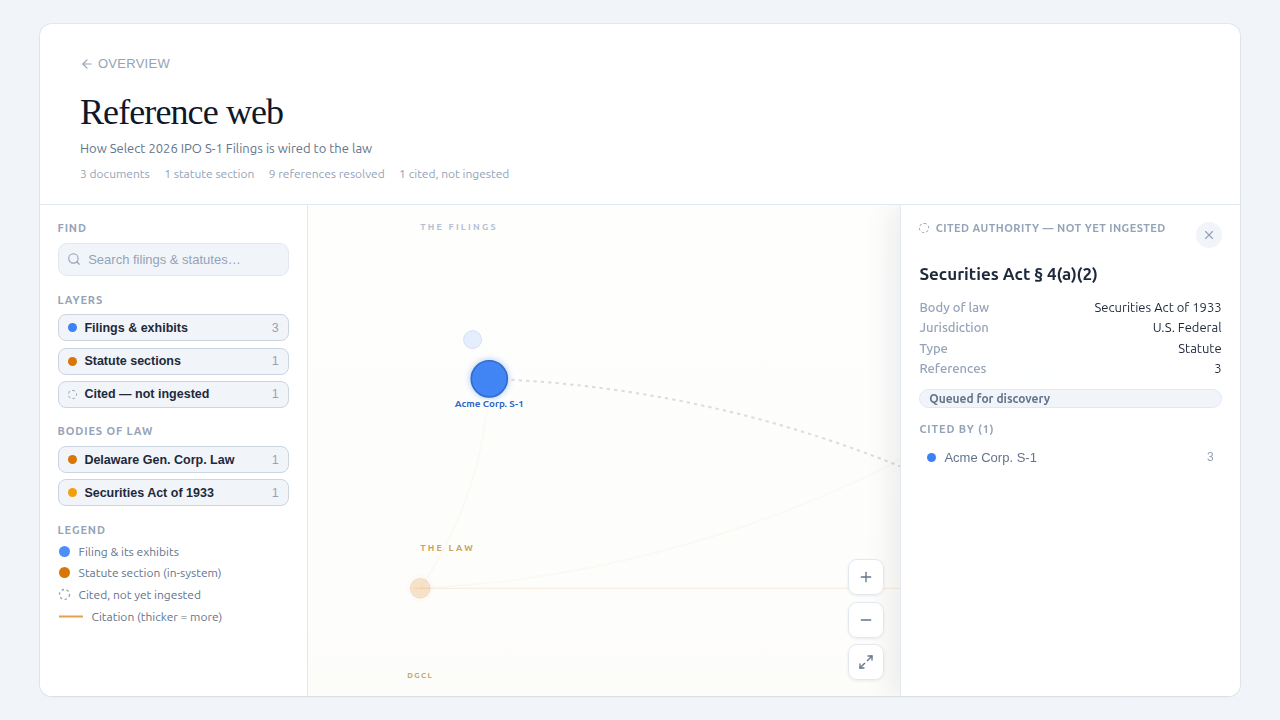
"Explore the full graph" opens the deep-linkable interactive explorer at ?view=graph (GovernanceGraphExplorer, sharing utils/governanceGraphLayout.ts with the glimpse). Filings sit above, the law shelf below; pan/zoom, search, and kind/authority filters (dim, don't reflow) let you navigate, and selecting a node opens a detail drawer.
The drawer is where in-flight authority discovery becomes legible: a cited-but-not- yet-ingested ghost node surfaces its body of law, jurisdiction, authority type, and frontier crawl state — the fields the static glimpse can't show.
Permissions¶
Reference enrichment and the authority crawl are write operations, so the runCorpusEnrichment mutation requires corpus UPDATE. Superusers are a scoped exception: they may trigger enrichment/crawl on any corpus they can READ without holding UPDATE — a retained admin privilege documented in docs/permissioning/consolidated_permissioning_guide.md. The exemption widens the write-trigger only; a superuser still cannot see a corpus they lack READ on (no blanket bypass). The /admin/authority/queue Queue tab and the authorityFrontier queries are superuser-gated at the node level.
Known limitations & follow-ups¶
- Open-vocabulary noise. The LLM tier trades some precision for recall. A normalization pass in
_derive_canonical_key/aextractfolds separator variants (eu:2017/1129→eu:2017-1129) and flags locator-lessact:*references — bodies of law / loose phrases with no section number (act:gaap,act:applicable-law,act:guam-administrative-adjudication-law) — asneeds_review, so they surface for triage but never auto-promote into the persisted reference web or crawl frontier. A future pass could fold known-body references into curatedAuthorityKeyEquivalencerows. - Re-run churn. Re-running the LLM tier produces ~10–15% new mention rows from span nondeterminism even at temperature 0 (idempotent on
canonical_key, but distinct spans yield distinct mention annotations). - Versioning. Amendments do not yet re-point already-
RESOLVEDreferences to the new section version — seedocs/architecture/reference-web-versioning.md. - Live per-document progress counter (deferred). Progress during a run is conveyed today by the RUNNING job status, the incrementally-appearing refs, and the "In progress" badge. A live per-document counter on the Authority Console Runs tab (e.g. "12 / 75 documents · 31 references") would need a transient
ENRICHMENT_PROGRESSWebSocket message emitted from bothapplypaths and a new handler inuseNotificationWebSocket→useEnrichmentJobs→EnrichmentJobList. Deferred as its own change (the WS path is not component-test-exercisable, so it needs a live verification pass).