Corpus Groups
A corpus group is a named bundle of corpora that an agent can retrieve across in a single step. It exists so a question that spans several collections — "what do our vendor agreements and our policy library say about subprocessors?" — does not require the user to pick one corpus and hope.
The retrieval side is the search_across_corpora agent tool (opencontractserver/llms/tools/core_tools/multi_corpus.py::asearch_across_corpora). It takes the group's slug or numeric ID, fans the query out over every member corpus, and returns hits grouped per corpus. Membership is resolved at call time from the group's corpora M2M — never from a config-time snapshot — so adding or removing a corpus takes effect on the very next question.
A group may also bind a default agent (agents.AgentConfiguration). That is the orchestrator persona for the group; its available_tools should include search_across_corpora.
Managing your groups
Sign in, open the avatar dropdown in the top bar, and choose Corpus Groups (route /corpus-groups). The panel is frontend/src/components/corpus_groups/CorpusGroupManagement.tsx.
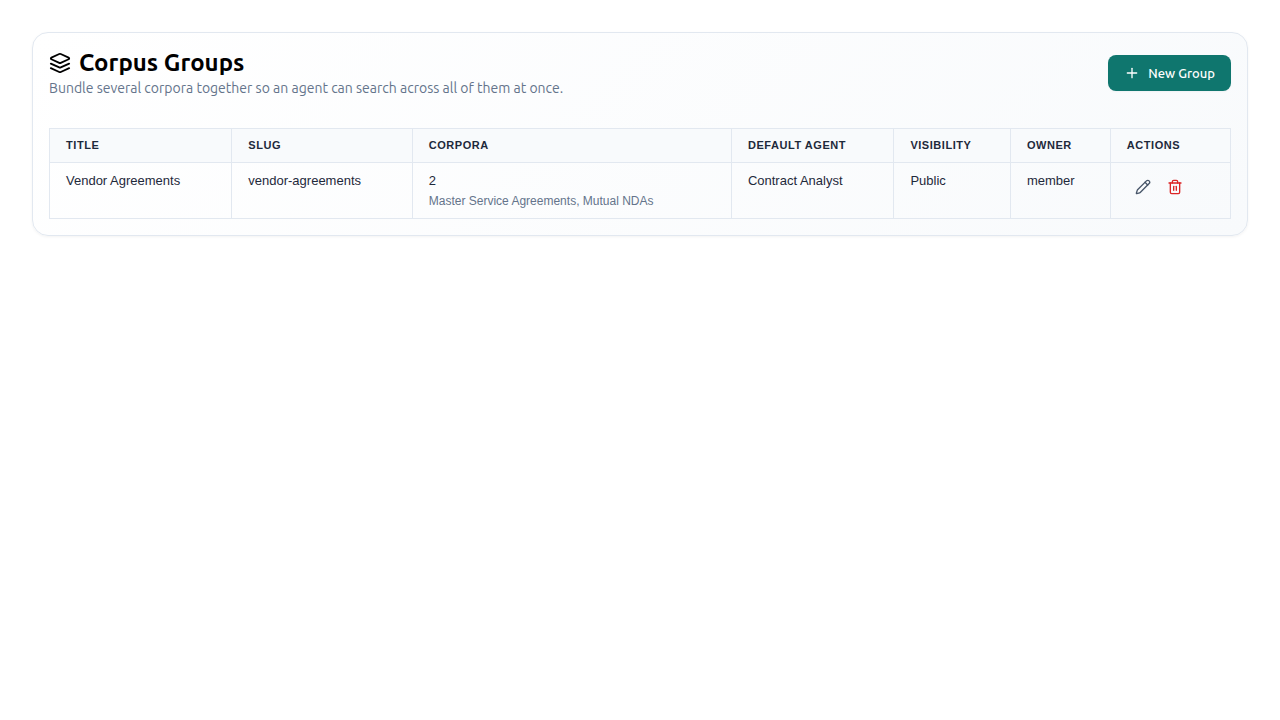
The list shows only the groups you created. There is no instance-wide listing and no superuser view — superusers see their own groups and nothing more, same as everyone else.
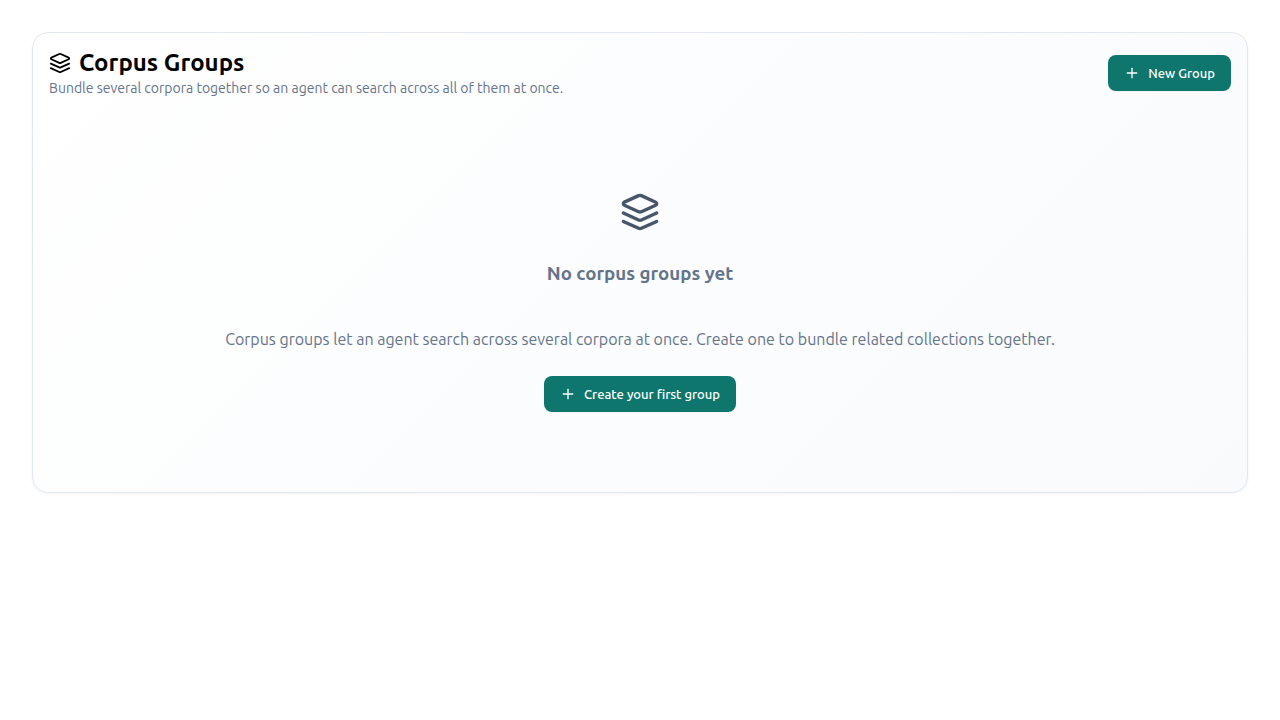
The create/edit form manages:
| Field | Notes |
|---|---|
| Title | Required. |
| Slug | Optional — auto-generated from the title when left blank. This is the handle an agent uses to name the group, so a readable slug is worth setting. An explicit slug that collides is rejected rather than de-duplicated. |
| Description | Free text. |
| Corpora | Multi-select over the corpora you can READ. Editing a group replaces its membership with what the form submits, so the form always carries the full desired set. |
| Default agent | Optional single-select over active agent configurations; clearing it unbinds the agent. |
| Public | Makes the group itself visible to anyone. It does not publish the member corpora. |
Deleting a group removes only the group; the member corpora are untouched.
Who can see what
Group visibility is the ordinary object-permission surface (creator, is_public, or an explicit guardian grant). Membership, however, is not a permission grant: a member corpus you cannot READ is never searched for you and never disclosed to you. The intersection is recomputed on every call by opencontractserver/corpuses/services/corpus_groups.py::CorpusGroupService.get_group_corpora_visible_to_user, so putting a corpus into a public group can never widen access to it. The bound default_agent is gated the same way.
See the Consolidated Permissioning Guide ("CorpusGroup (multi-corpus retrieval bundles)") for the full rule set and the anonymous-access behaviour.
Django admin
There is no CorpusGroup admin page. The registration was removed from opencontractserver/corpuses/admin.py in favour of this GUI (#2141) so there is exactly one management surface — the admin form was superuser-only and wrote straight to the model rather than through CorpusGroupService.