Authoring an Authority Pack¶
An authority pack is a single, self-contained directory that stands up a body of law for a jurisdiction — its citation taxonomy, optional scraper, target corpora, and agent personas — as data + one small module, with no bespoke Django app. Because everything for one authority lives in one place, a pack is copy-to-add, delete-to-remove, copy-to-port: drop the directory into another OpenContracts install and the authority comes with it.
This is the operator/author how-to. For the management UI see Authority Console; for the detection→discovery→crawl engine see Reference-Web Enrichment; for the original design rationale and the gap/phasing analysis see the proposal, 0002 — Authority Packs.
Packs are deployment data, not product code. The tree ships one worked example (bolivia) so the format has a reference implementation and the machinery has something to exercise. A real body of regulation — the corpora an install actually curates, with its own legal-review state, refresh cadence, and publisher relationships — belongs in its own repository and is sideloaded (see Installing a sideloaded pack). Nothing about a pack needs to be in this tree to work: taxonomy, scraper, SSRF allowlist entries, and corpus definitions all travel inside the directory.
Anatomy of a pack¶
<pack>/
  pack.yaml                          # the manifest (below)
  authority_mappings.<name>.yaml     # taxonomy: prefixes / equivalences / rewrite_rules
  specs/<area>.json                  # curated section content (one doc per section)
  personas/<area>.txt                # agent persona → Corpus.corpus_agent_instructions
  charters/<area>.yaml               # v2: corpus scope and legal-review ownership
  metadata/<schema>.yaml             # v2: typed AuthoritySourceRecord fields
  relationships.yaml                 # v2: canonical-key relationship declarations
  sources.yaml                       # OPTIONAL: source plan for the out-of-process collector
  providers/<name>_provider.py       # OPTIONAL: citation-keyed scraper (discovered from here)
  discovery_providers/<name>.py      # OPTIONAL: listing-index crawler (discovered from here)
  fixtures/                          # OPTIONAL: test/golden data; never legal approval
Two worked examples, for two different purposes. Read whichever matches what you are writing:
| Example | Schema | Read it for |
|---|---|---|
opencontractserver/enrichment/data/authority_packs/bolivia/ | v1 | The shipped, installable pack — taxonomy + curated content + a Spanish persona. No scraper: its sources are listing-page, not key-addressable. |
opencontractserver/tests/fixtures/authority_packs/example_utility/ | v2 | A complete, deliberately fictional multi-corpus pack exercising every v2 slot — slugs, charters, typed metadata, relationships, prefix binding, and a sources.yaml source plan. |
example_utility lives under tests/fixtures/ rather than the in-tree pack root on purpose: authority_pack_dirs() enumerates every immediate subdirectory of that root, so a fixture placed there would ship as an installable pack on every deployment. Tests mount it explicitly via override_settings(AUTHORITY_PACK_PATHS=[…]), which is also the cheapest way to try a pack of your own without committing it.
Each artifact binds to an existing extension seam, so the runtime needs zero changes to accept a new pack:
| Slot | Lives in | Binds to | Required |
|---|---|---|---|
| Taxonomy (prefixes / equivalences / rewrite rules) | authority_mappings.<name>.yaml | AuthorityNamespace / AuthorityKeyEquivalence via AuthorityMappingLoader | one of taxonomy or corpora |
| Curated content (per legal area) | specs/<area>.json | bootstrap_authority_corpus() → keyed authority documents | optional |
| Agent persona (per corpus) | personas/<area>.txt | Corpus.corpus_agent_instructions | optional |
| Fetch provider ("scraper") | providers/<name>_provider.py | BaseAuthoritySourceProvider, discovered from the pack dir | optional |
| Discovery provider (listing-index crawler) | discovery_providers/<name>.py | BaseAuthorityDiscoveryProvider, discovered the same way | optional |
| Corpus charter | charters/<area>.yaml | Load-time scope/review declaration (schema v2) | required in v2 |
| Typed metadata schema | metadata/<schema>.yaml | Existing Fieldset / Column / Datacell metadata path | optional |
| Authority relationships | relationships.yaml | Canonical-key AuthorityRelationship rows | optional |
| Source plan | sources.yaml | The out-of-process collector (scripts/authority_import/) → corpus-export ZIPs | optional |
| Corpus namespace binding | pack.yaml corpus authority_prefixes: | Existing pack-owned AuthorityNamespace rows → exact target corpus | optional |
| Source hosts (for a scraper) | pack.yaml source_hosts: | the SSRF allowlist, merged at runtime | optional |
| Provider credentials | the PipelineSettings encrypted-secrets vault (not a pack file) | get_component_settings(), keyed by provider class path | optional |
Secrets never live in a pack. A scraper that needs an API key reads it from the singleton PipelineSettings encrypted-secrets vault (keyed by the provider's full class path), edited through System Settings — see the Authority Console's Scrapers & Credentials tab. Pack files stay safe to commit and copy.
The pack.yaml manifest¶
Schema v1 remains supported for existing packs. New packs that need durable corpus identity, charters, typed source metadata, or relationships should use schema v2:
schema_version: 2
name: example_electric
display_name: "Example Electric Authorities"
jurisdiction: us-example
mappings: authority_mappings.example.yaml
metadata_schema: metadata/authority_source_record.yaml  # pack-wide default
relationships: relationships.yaml
sources: sources.yaml                 # optional; read only by the out-of-process collector
source_hosts:
  - example.gov                       # bare host; no scheme, port, or path
corpora:
  - slug: example-electric-rules      # required in v2; stable deployment identity
    title: "Example Electric Rules"
    description: "Controlling electric-service rules."
    charter: charters/example-electric-rules.yaml
    spec: specs/example-electric-rules.json
    authority_prefixes:                # optional, explicit namespace ownership
      - example-electric-rule
    persona: personas/example-electric-rules.txt
    metadata_schema: metadata/authority_source_record.yaml  # optional override
    default_authority_weight: CONTROLLING
    preferred_embedder: "..."         # optional corpus model overrides
    preferred_llm: "..."
In v2, each corpus must declare a lowercase, hyphenated slug and a charter whose YAML mapping contains at least a non-empty purpose. The slug—not a mutable display title—is the stable identity used to converge a corpus across pack reloads and to route live source records. A slug collision owned by a different creator, or a conflicting pre-existing title/slug, fails during preflight rather than creating a second corpus. A charter can also record scope, exclusions, authority tiers, update expectations, and review owners; those fields are operational declarations and do not themselves grant legal approval.
An optional corpus authority_prefixes list binds one or more prefixes from this pack's mappings: file to that exact installed corpus. The declaration is explicit: the loader never infers ownership from section keys. A prefix may be bound by at most one corpus in a pack, and the loader refuses undeclared, manual, foreign-owned, or already differently bound namespaces. Once bound, the namespace becomes corpus-scoped (is_global: false). This is the trust anchor used by targeted authority ZIP imports before they may reconcile typed metadata or provider relationships; the importer itself remains fail-closed.
Bind every prefix whose documents you intend to sideload. "Optional" is a schema statement, not a recommendation. An unbound prefix does not degrade gracefully: _reconcile_imported_authority_metadata returns immediately when the target corpus owns no prefix, so the corpus imports every document successfully, keeps each provider-authored edge in custom_meta["relationships"], and creates no AuthorityRelationship row at all — no error, no warning, no failing import. The only visible symptom is an authority graph that is quietly missing edges. (This stranded 154 of 396 declared edges across one deployment's four packs before every prefix was bound.) Because binding is a property of a pack's own data, a pack repository should assert it in its own suite; the loader-side rules — a prefix bound by at most one corpus, no undeclared/manual/foreign/already-bound namespaces — are covered by test_authority_pack_loader.py.
Leaving a prefix unbound is right only when its documents are never sideloaded into a corpus of this pack — for example a prefix declared purely so citations to an external authority resolve. When one canonical namespace genuinely spans two corpora, bind it to the corpus that owns the authority's current records and declare the other corpus's edges in relationships.yaml, which is not gated by the binding. A pack with a current-tariff corpus and a tariff-history corpus does exactly that: the tariff prefix binds to the current-tariff corpus, and the history corpus's EFFECTIVE_VERSION_OF / SUPERSEDED_BY edges are declared instead.
default_authority_weight must come from the shared AuthorityWeight vocabulary. The loader stamps it as a soft default on inline seed sections that do not declare metadata.authority_weight. A pack reload fills a missing value but preserves any existing live-provider or curator value. Every AuthoritySourceRecord must still carry its own reviewed weight.
metadata_schema points to a version-1 YAML schema with a non-empty fields list. Each field declares name, a supported metadata data_type, optional help_text, and optional validation_config; CHOICE and MULTI_CHOICE fields must provide validation_config.choices. Loading creates missing fields through the normal Fieldset / Column metadata subsystem. It refuses to replace a curator-owned column with a different type.
relationships points to YAML shaped as {schema_version: 1, relationships: [...]}. Each declaration contains source_key, relationship_type, target_key, optional verified, and optional metadata. The controlled relationship vocabulary is CITES, AMENDS, SUPERSEDES, SUPERSEDED_BY, ADOPTS, PARTIALLY_ADOPTS, REJECTS, IMPLEMENTS, INTERPRETS, FILED_IN, RESPONDS_TO, REVISES, INCORPORATES, REQUIRES_FORM, EXCEPTION_TO, and EFFECTIVE_VERSION_OF. Edges are keyed independently of a particular document version, so they can cross corpora. Canonical keys remain authoritative; the existing governance graph resolves visible current documents and corpora through DocumentPath at query time. This also keeps independently installed copies of the same pack isolated. Reloads preserve manually owned edges, curator metadata overrides, and foreign-origin managed edges. The owning pack/provider may revoke an erroneous verified: true determination on its managed row; convert an edge to manual ownership to freeze a curator decision.
The taxonomy YAML (mappings:) uses the same schema as the shipped baseline opencontractserver/enrichment/data/authority_mappings.yaml: prefixes: (display_name / jurisdiction / authority_type / aliases), optional equivalences: (from_key/to_key), and optional rewrite_rules: (regex pattern/replacement). jurisdiction is free text (any value); authority_type must be one of the controlled vocabulary in opencontractserver/enrichment/constants.py (ALL_AUTHORITY_TYPES).
A section spec is {aliases?: [..], sections: [{key, heading, text, source_url?, metadata?, relationships?}]} (aliases and relationships must be lists, never bare strings). These specs are curated bootstrap locators or small seed documents; live providers should emit the richer source record described below. The loader validates the whole pack before any DB write, including every spec, persona, charter, metadata schema, relationship declaration, source host, stable slug, and declared source-key prefix. Taxonomy, corpus configuration, seed content, metadata schema, and relationships then converge in one transaction.
Sideloading externally built corpora¶
A pack does not need to acquire its corpus content inside OpenContracts. For deployments whose crawlers or collection pipelines run elsewhere, produce a normal OpenContracts corpus-export ZIP for each declared corpus.
An administrator installs the trusted server-deployed pack from Authority Console → Authority Packs, then reopens its preflight and selects Import corpus ZIP beside the matching installed corpus. That action reuses the existing corpus-export importer and targets the pack corpus by its server-issued corpus ID. The pack's stable slug, owner, and visibility remain attached to the destination; documents, annotations, labels, folders, metadata, and supported corpus configuration are hydrated from the export.
For an installed authority-pack target, documents whose exported custom_meta.canonical_key matches exactly converge onto the existing pack document path. An unchanged re-import is skipped; changed content creates the next version on that path. The importer fails closed if the target already has more than one path for the same canonical key. Exports without canonical-key metadata retain the existing corpus-export path/title merge semantics.
This workflow requires no provider module or source_hosts declaration and does not make OpenContracts contact the publisher. Provenance collected by the external pipeline should travel in the exported document paths and metadata.
Collecting content out of process (the source plan)¶
You do not have to build those ZIPs by hand. A pack may declare a source plan in sources.yaml, and the standalone builder scripts/authority_import/build_authority_imports.py runs it outside the application — reusing the pack's own registered discovery and source providers — and writes <pack>/imports/<corpus-slug>.zip plus an index and a scrape report:
python scripts/authority_import/build_authority_imports.py \
  --rights-approved /srv/authorities/<repo>/packs/<pack>
Each plan entry names one candidate mode (discovery_provider + index_urls, an explicit candidates list, or canonical_keys) and an ingestion_mode: full_content runs the normal authority rights gate, while link_only discovers and locates but never fetches publisher bytes. --rights-approved records the external collector's per-build decision for LICENSED / REVIEW_REQUIRED records; without it those records fail closed. It does not publish the corpora, approve graph edges, or waive publisher restrictions.
The web app never runs the scraper on this path — the operator uploads the generated ZIPs through Authority Packs → Import corpus ZIP. Full field reference, the rights and TLS rules, and the pre-import verification checklist live with the builder in scripts/authority_import/README.md; example_utility/sources.yaml is a working two-source plan.
Shipping a scraper inside the pack¶
A live-fetch provider is the one irreducibly-Python slot (every source's HTML/XML/ API shape differs). It now lives with its pack, under <pack>/providers/, instead of in core's pipeline/authority_source_providers/:
- Subclass
BaseAuthoritySourceProvider(opencontractserver/pipeline/base/base_authority_source_provider.py): declaresupported_prefixes/license/priority/requires_approval/enabledas class attributes, and implement the pure_locate_impl(canonical key → request plan) and_fetch_impl(request → records). The shippedcfr_provider.py/us_code_provider.py/federal_register_provider.pyare worked references. - Drop the module in
<pack>/providers/. The pipeline registry discovers it from the pack directory at startup — no registration call, no edit to core. - List the source's host(s) in
pack.yamlsource_hosts:. Every fetch stays SSRF-gated (HTTPS-only, public-IP, per-redirect revalidation, size caps); the pack only widens which hosts are reachable, and only once you install it (the install IS the trust decision; each added host is logged). In-pack source and discovery providers derive their allowlist from their own manifest. They cannot borrow a host declared by another installed pack, and both the initial URL and redirect-final host must belong to that manifest. - Put any credentials in the secrets vault (above), never in the pack.
Importing a pack's own modules¶
A pack with more than one provider usually wants a shared helper (publisher identity derivation, a parsing utility) at its pack root. Reach it with a relative import, never an absolute dotted path:
# in <pack>/providers/example_provider.py
from ..publisher_identity import derive_canonical_key   # ✅ works in-tree and sideloaded
In-pack component modules are imported by file path under a synthetic _authority_pack.<pack>.… namespace whose parent packages the registry creates (opencontractserver/pipeline/registry.py::_ensure_synthetic_package). Relative imports resolve against that namespace identically wherever the pack is mounted, which is what "a pack is copy-to-port" requires.
An absolute in-tree path (from opencontractserver.enrichment.data.authority_packs.<pack>.helper import …) appears to work only while the pack sits in this repository and is also importable as a real Python package. The moment it is sideloaded that import raises and every provider in the module silently fails to register — the pack installs, the corpora appear, and nothing fetches. This is not hypothetical: it stranded 15 providers across two packs on their first sideload. Covered by PackSiblingImportTests in test_authority_pack_providers.py.
Two related rules:
- Pack directory basenames should be unique across the in-tree root and every configured root/path. Colliding basenames are disambiguated with a path digest and logged as a warning, but the readable namespace is worth keeping.
- Re-mounting a pack name from a different directory is safe. The registry drops the old directory's cached submodules, so a swapped pack cannot hand back the previous pack's helper.
The shared AuthoritySourceRecord¶
Existing providers may continue to return the compact AuthoritySection(key, heading, text, source_url) shape. New pack providers should return AuthoritySourceRecord from opencontractserver/enrichment/authority_sources.py. It is the shared record contract for every authority pipeline, not a per-deployment importer. It carries:
- stable identity and routing:
canonical_key,source_identifier,source_url,corpus_slug,authority_family,parent_key; - classification: shared core
authority_type, pack-levelinstrument_type,authority_weight, publisher, and jurisdiction; - lifecycle: filed/issued/published/effective dates, status, current-version flag (tri-state:
true,false, or unknown), and version label; - provenance: original source bytes, MIME type, retrieval time, computed SHA-256
content_hash, per-recordrights_status, provider metadata, and typed relationships; - publisher identity evidence: typed evidence values plus a provider callback that independently derives the requested canonical key from those values.
The record validates the controlled vocabularies and dates, verifies a supplied hash against the original bytes, and deterministically extracts searchable text from supported text, HTML, PDF, DOCX, XLSX, and XML sources. The original source artifact still enters the existing corpus import/versioning path; this contract does not create a second persistence system.
authority_type continues to use the core ALL_AUTHORITY_TYPES vocabulary. Domain-specific distinctions belong in instrument_type and authority_weight; a pack must not expand the core vocabulary just to distinguish a tariff, protocol, form, testimony, or similar source.
Rights are decided per record¶
Public web access is not a copyright or license determination. AuthoritySourceRecord.rights_status defaults to REVIEW_REQUIRED:
| Status | Ingestion behavior |
|---|---|
PUBLIC_DOMAIN | May pass the rights gate without a separate approval. |
LICENSED | Parks at pending_approval until an authority administrator approves that candidate. |
REVIEW_REQUIRED | Parks at pending_approval until an authority administrator approves that candidate. |
LINK_ONLY | Never ingests source bytes; it remains a discoverable locator. |
A fetch response must have one unambiguous rights disposition. Mixed legacy/rich records or mixed record statuses fail closed rather than allowing an approved record to authorize a link-only sibling. Approval is durable, scoped to authority-ingestion, records the approving user and time, and is honored only for the exact normalized response that was reviewed. Its fingerprint binds the selected provider and request URL/parameters to every returned record's canonical identity evidence, normalized source URL, redirect-final host, content hash, and rights status. Operators approve a pending_approval row from the Authority Console Queue; re-fetching then uses the recorded approval only if that complete fingerprint still matches. Changed bytes, a changed source URL, or any other bound provenance change parks the new response for a fresh review. The usual HTTPS, SSRF, source-host, and publisher-evidence checks still apply.
Discovering UNKNOWN documents (listing-index crawl)¶
A BaseAuthoritySourceProvider needs a known canonical_key — it cannot find documents nobody has cited yet. For a publisher whose site is a browsable listing/index (not key-addressable) — the motivating case is Bolivia's Gaceta Oficial, per 0002 — Authority Packs §7 — use BaseAuthorityDiscoveryProvider (opencontractserver/pipeline/base/base_authority_discovery_provider.py) instead. It crawls index page(s) and lists candidates (canonical_key + url + metadata) without fetching or ingesting them; AuthorityFrontierService .seed_from_discovery then queues the candidates for the normal discovery runtime.
The shipped reference implementation, ListingIndexDiscoveryProvider (opencontractserver/pipeline/authority_discovery_providers/listing_index_provider.py), is config-driven and jurisdiction-agnostic: supply a ListingIndexRule (a link regex + a canonical-key template) rather than writing new code. Ship one in <pack>/discovery_providers/*.py (discovered the same way as providers/) only if a publisher's markup needs bespoke parsing beyond that rule.
The operator surface is the discover_authority_candidates management command (--dry-run previews without seeding). Select an installed pack provider by class name or full class path:
python manage.py discover_authority_candidates \
  --provider ExampleRuleIndexDiscoveryProvider \
  --index-url https://example.gov/rules \
  --dry-run
Provider class names must be unambiguous; use the full class path when two installed packs declare the same name. --provider cannot be combined with the config-driven --link-pattern, --canonical-key-template, or --prefix arguments. Without --provider, those three arguments remain required. --index-url is repeatable for pagination in both modes.
Discovery only lists candidates and queues frontier rows; it never downloads their document bodies or bypasses the source-record rights gate. A mixed-rights index may set link_only_discovery = True so its links can be enumerated. That opt-in does not authorize ingestion: each fetched AuthoritySourceRecord is still evaluated independently, and a LINK_ONLY record remains non-ingestable.
Repeated discovery runs use a stable observation identity made from the discovery provider, canonical key, normalized URL, title, and complete provider-owned listing metadata. Previously recorded identities are skipped before applying the per-run cap, so a small cap still advances through a large index. A publisher moving the same canonical key to a different URL—or changing its current/historical or document-type metadata—produces a new reviewable candidate instead of being hidden by key-only deduplication.
Installing from the pack registry (one command)¶
Published packs live in their own repository — Open-Source-Legal/authority-packs (CC BY-SA 4.0; one top-level directory per pack) — so a deployment installs only the jurisdictions it wants and the MIT platform stays untangled from pack content licensing. install_authority_pack is the fetch+install wrapper:
docker compose -f local.yml run --rm django python manage.py \
  install_authority_pack --list                     # what's available
docker compose -f local.yml run --rm django python manage.py \
  install_authority_pack fort_worth --creator <username> --check   # preflight
docker compose -f local.yml run --rm django python manage.py \
  install_authority_pack fort_worth --creator <username> --public  # install
It downloads the registry tarball (--repo/--ref override AUTHORITY_PACK_REGISTRY_URL and the default main; --tarball skips the network entirely for air-gapped installs), extracts the one pack into AUTHORITY_PACK_INSTALL_DIR (an implicit bundle root, auto-discovered — no env-var wiring needed), and delegates validation + install to load_authority_pack. The install dir is a managed fetch cache: re-installing a pack replaces its directory, and deployments that recreate containers should volume-mount it (pack content persists in the database, but the grammar tier re-reads taxonomy extensions from disk at process start). The usual restart rule applies after install.
Installing a sideloaded pack¶
This is the normal path. The pack lives in its own repository; the install points at it and restarts.
One repository of packs → one variable. AUTHORITY_PACK_ROOTS takes directories of packs, the same shape as the in-tree root, so a pack repo mounts whole:
# packs live at /srv/authorities/<repo>/packs/{pack_a,pack_b,...}
AUTHORITY_PACK_ROOTS=/srv/authorities/<repo>/packs
One pack → one entry. AUTHORITY_PACK_PATHS takes individual pack directories, for a single pack or one mounted from an unusual location:
AUTHORITY_PACK_PATHS=/srv/authorities/pack_a,/srv/authorities/pack_b
Both are comma-separated and empty by default; a pack reachable through both is registered once. A path that is not a directory is logged and skipped rather than failing worker boot. Under Docker the directory has to be mounted into the container — the path is resolved inside it, not on the host.
A root is scanned, so only subdirectories containing a pack.yaml count. That makes a root pointed one level too deep (at a pack rather than at the bundle) contribute nothing, instead of surfacing that pack's own charters/ and specs/ as broken packs. Explicit AUTHORITY_PACK_PATHS entries are deliberately not filtered that way: you named that directory, so a missing manifest must surface as an invalid pack you can repair rather than vanish.
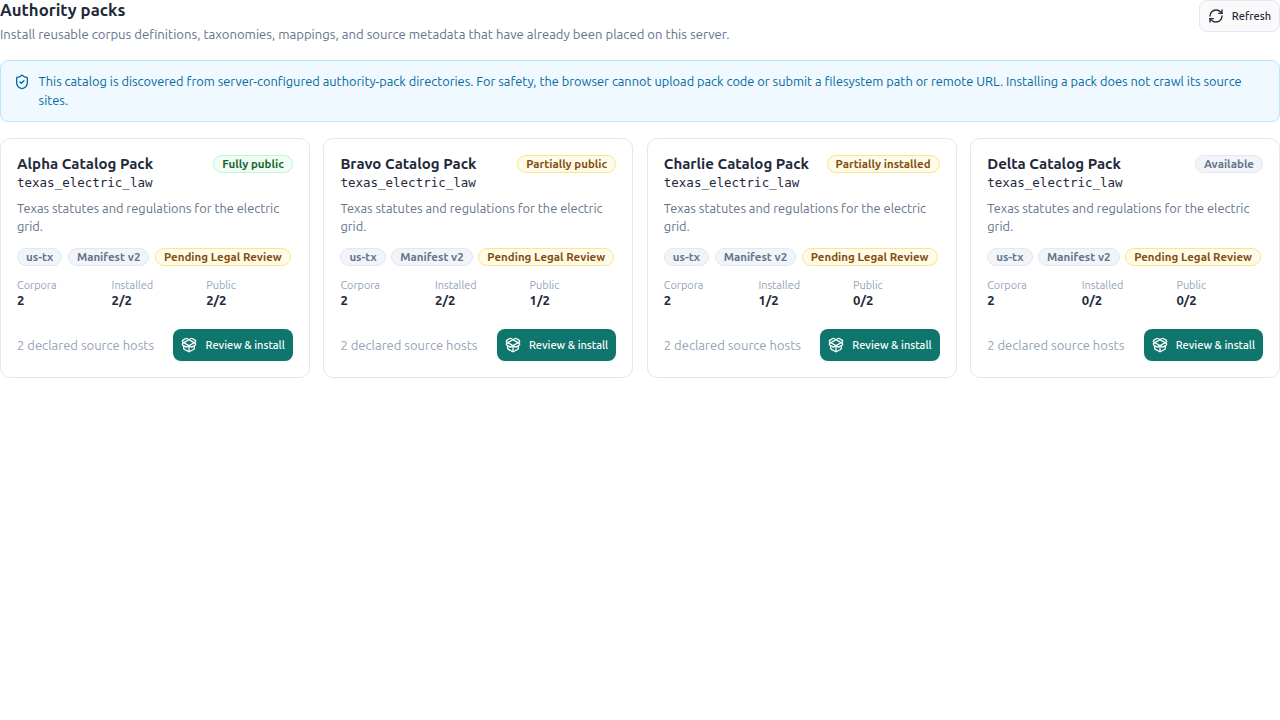
Confirm the server can see it. Configured packs appear in Admin Settings → Authority Console → Authority Packs:
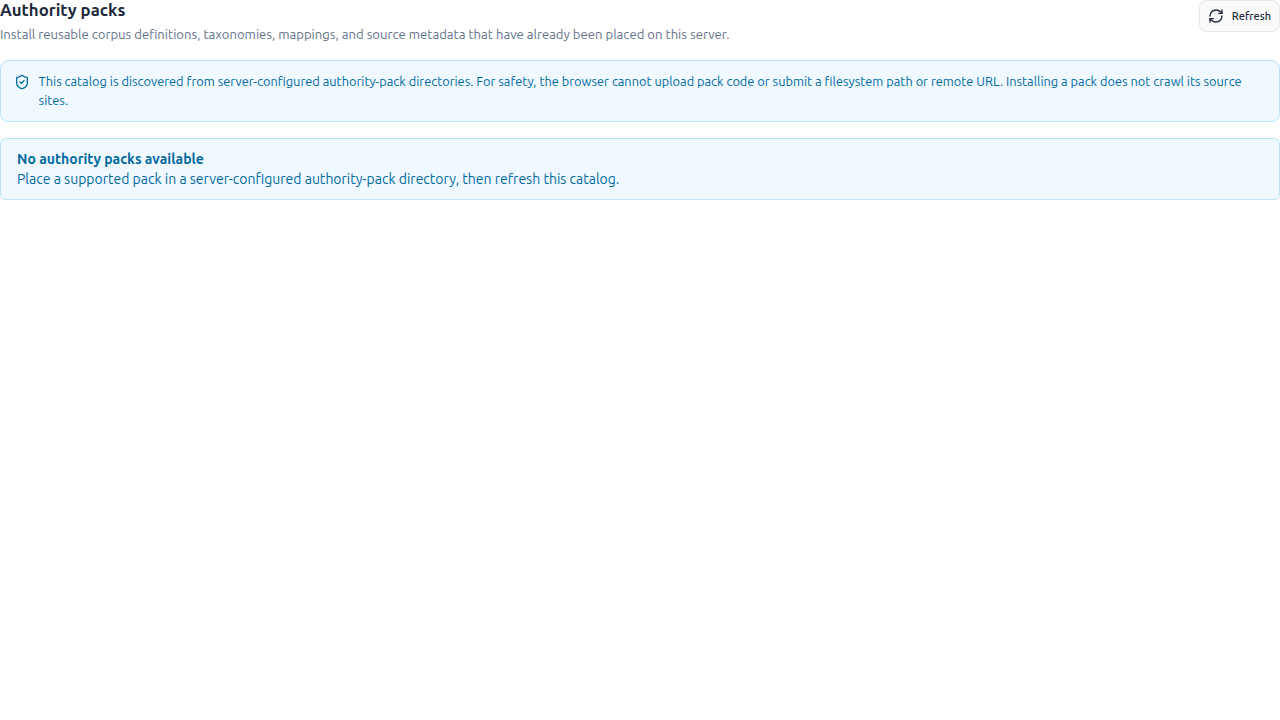
An empty catalog means no configured directory yielded a pack — most often a host path that was never bind-mounted into the container:
Verify before installing. A sideloaded pack is code and data you did not necessarily write. --check runs the same validation as the Authority Console preflight and writes nothing:
docker compose -f local.yml run --rm django python manage.py load_authority_pack \
  --path /srv/authorities/<repo>/packs/<pack> \
  --creator <username> --check
It prints the manifest fingerprint, declared source hosts, approval state, and per-corpus plan, and exits non-zero if the pack is invalid.
Install. Drop --check to converge taxonomy, corpora, seed content, personas, metadata schemas, and relationships in one transaction. Then restart so the registry and SSRF allowlist pick up the pack's providers/ module and source_hosts — discovery happens at registry build.
An administrator can do the same thing without a shell. Review & install on a catalog card runs the identical validation and shows what the install would do before anything is written (a pack that failed validation instead shows a disabled Review pack button — repair it on disk first):
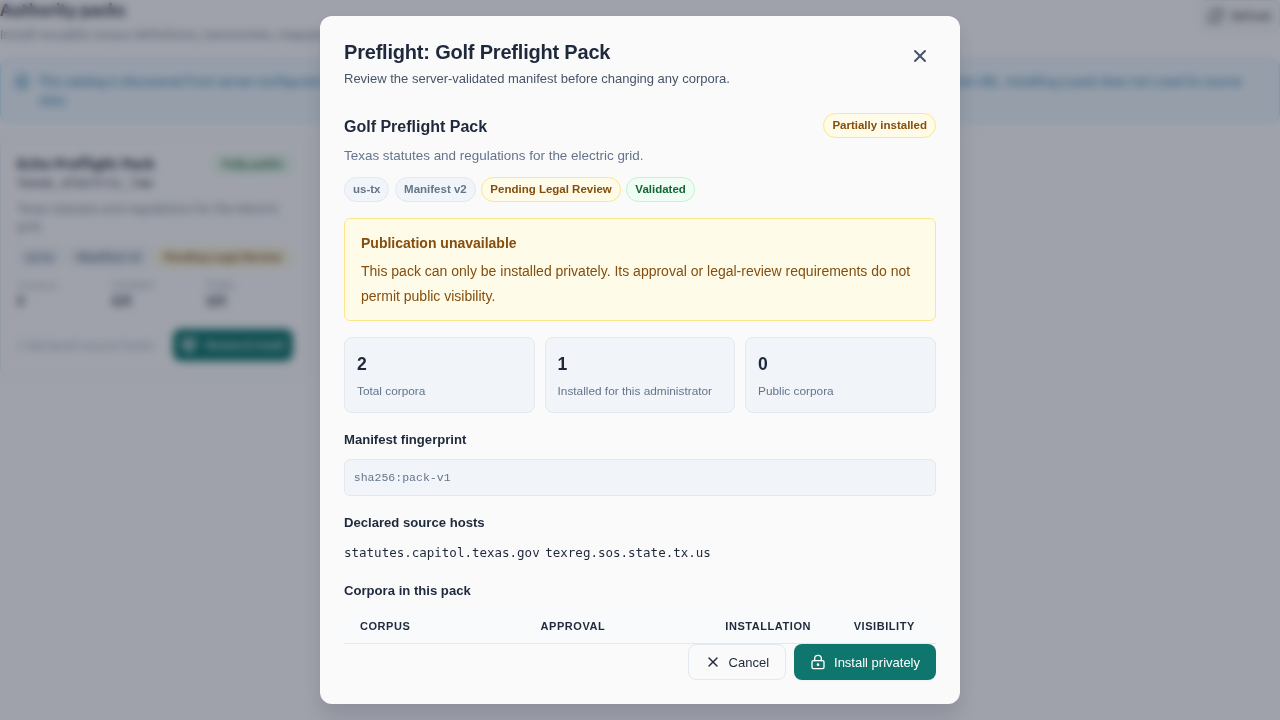
The fingerprint shown here is sent back with the install, so a pack edited on disk in between is rejected rather than quietly installing something else. Installation is private by default; publish is a separate opt-in that stays disabled while a declared charter is unapproved or pending_legal_review. See Authority Console § Authority Packs tab.
Acceptance runs. A pack repository that keeps its own end-to-end acceptance spec (install the packs, import the prepared ZIPs, assert the resulting corpora) runs it against this frontend with E2E_RUN_AUTHORITY_IMPORTS=true, which raises Playwright's timeouts for a real-stack install of large corpora. No in-tree spec sets it — the packs, their exports, and the spec all live with the deployment.
Add / remove / copy¶
Add (in-tree). Reserved for the shipped example pack. Committing a pack under opencontractserver/enrichment/data/authority_packs/ installs it on every deployment, offers it in every Authority Console catalog, and has its providers imported by every worker — a deliberate, reviewable decision rather than the default place to put a pack. Load its DB-side (taxonomy + content + personas):
docker compose -f local.yml run --rm django python manage.py load_authority_pack \
  --path opencontractserver/enrichment/data/authority_packs/<pack> \
  --creator <username>
load_authority_pack is idempotent and re-runnable. Add --public only when the corpus material and the installation's review policy permit publication; the flag controls corpus visibility, not copyright or legal approval. Restart so the registry/SSRF allowlist pick up any providers/ module and source_hosts.
Authority source syncs compare the SHA-256 hash of the original source bytes while holding the existing active-path versioning lock. Changed bytes create a new Document version. Identical bytes do not fabricate a content version: identical metadata returns unchanged, while changed retrieval/provenance or document metadata records a same-version DocumentPath metadata event and returns metadata_updated. This deduplication is opt-in for authority syncs; ordinary user uploads retain their existing every-upload-is-a-version behavior. Curator-owned namespace rows, relationship edges, and metadata overrides are not silently clobbered.
Add (out-of-tree / copy to another install). See Installing a sideloaded pack above. The pack's provider and hosts travel with the directory — nothing in core needs editing.
Remove. Delete the pack directory (or drop it from AUTHORITY_PACK_ROOTS / AUTHORITY_PACK_PATHS) and restart — its provider and source_hosts stop being discovered immediately. The already-loaded taxonomy/content rows persist (the loader upserts, it does not delete prefixes dropped from a YAML); remove them deliberately via the Authority Console if you want them gone.
Prefix ownership (what a re-load can and cannot clobber)¶
Namespace rows are ownership-partitioned so no writer silently overwrites another (issue #2057):
- A curator edit through the console stamps
source="manual"— no loader run ever touches the row again. - A corpus-linked namespace (
is_global=False) is bootstrap-owned — same. - A baseline row is stamped with the writer that loaded it (
AuthorityNamespace.baseline_origin: the pack's manifestname, or"core"for the shippedauthority_mappings.yaml). Re-loading the same pack updates its own rows (its YAML stays authoritative); a load that hits a prefix a different origin owns skips it with a warning (counted asskipped_foreign_baselinein the command output) — first writer wins. Resolve a genuine collision by dropping the prefix from one YAML, or by curating the row through the console (making it manual-owned). The pack namecoreis reserved for the shipped baseline, and a pack'sname:must be unique across every installed pack directory (in-tree + sideloaded): two directories declaring the same name are treated as the same pack — they co-own their prefixes with no collision guard between them.
To converge the whole installed taxonomy — the shipped baseline plus every installed pack's mappings — in one idempotent run (e.g. after editing several packs' YAMLs):
docker compose -f local.yml run --rm django python manage.py load_authority_mappings --include-packs
load_authority_pack stays the full per-pack loader (taxonomy + content + personas); load_authority_mappings --include-packs re-converges taxonomy only, across every installed pack at once.
Carrying a jurisdiction's citation vocabulary in the pack¶
Beyond prefixes/equivalences/rewrite_rules, a pack's mappings YAML may carry two optional sections so a new jurisdiction's citation vocabulary travels with the pack (merged onto the shipped Python baseline at runtime; the baseline always wins a collision — a pack extends, never overrides):
# in <pack>/authority_mappings.<name>.yaml
shape_rules:                       # classify a numbered prefix family without a core edit
  - pattern: '^bo-ley-\d+$'        # e.g. bo-ley-1234
    jurisdiction: bo
    authority_type: statute        # must be one of ALL_AUTHORITY_TYPES

abbreviations:                     # Bluebook-style abbreviations the Tier-2a extractor matches
  state:
    "Bol. Civ. Code":
      prefix: bo-civ
      jurisdiction: bo
      authority_type: statute
      # Optional. Require §, Section, or Sec. before the locator so an edition
      # year such as "Bol. Civ. Code 2026" is not treated as section 2026.
      requires_section_marker: true
  municipal:
    "La Paz Mun. Code":
      prefix: muni-la-paz
      jurisdiction: bo-la-paz
      authority_type: municipal-ordinance
These are read from every installed pack (in-tree + sideloaded) and validated fail-fast by load_authority_pack. Tests: test_authority_pack_taxonomy.py.
requires_section_marker defaults to false for compatibility with abbreviations whose conventional form permits a bare locator. Set it to true when the named authority is also commonly followed by an edition/publication year; the existing shared extractor then requires §, Section, or Sec. without adding a source-specific grammar.
What is still core (shared engine vocabulary)¶
Two things stay in the engine rather than per-pack, by design — they are shared vocabulary, not per-authority config:
- The
authority_typecontrolled vocabulary (ALL_AUTHORITY_TYPES): every pack draws its types from this one shipped set (it is wired into model fieldchoices); a pack picks a type, it does not invent one. - The Tier-2a citation-form parsing grammars (the regexes in
grammars.pythat turn"15 U.S.C. § 78j"into a canonical key): these are parsing logic, not authority configuration. A pack declares its prefixes/aliases (Tier-1) and its shape-family classification + abbreviations (above) as data; only a genuinely new citation form would need a grammar change in core.
Verify the load¶
- Authority Console → Registry tab: the pack's prefixes appear as
AuthorityNamespacerows (scope/jurisdiction/type/aliases). - Authority Console → Scrapers tab: a shipped provider appears with its prefixes / license / priority / credential status.
- The seeded corpora are queryable, each answering in its pack persona.
Tests for the mechanics live in opencontractserver/tests/: test_authority_pack.py (manifest + install service), test_authority_pack_loader.py (convergence, idempotency, curator-state preservation, atomic abort, prefix binding — against the example_utility fixture), test_authority_pack_sideload.py (the AUTHORITY_PACK_ROOTS / AUTHORITY_PACK_PATHS contract), test_authority_pack_providers.py (in-pack provider discovery and sibling imports), test_authority_pack_taxonomy.py (shape_rules / abbreviations), test_authority_source_hosts.py, test_authority_sources.py, and test_authority_ingestion_invariants.py.