Ingesting Authorities & Adding Providers¶
This is the operator how-to for the authority-discovery side of reference-web enrichment: how to ingest a source the system already supports, and how to add a new provider so a body of law that currently parks at unsupported becomes ingestable.
For the architecture behind all of this — the detection tiers, the provisional lifecycle, the crawl frontier, and the discovery_state machine — see Reference-Web Enrichment & Authority Discovery. This guide assumes that background and stays practical.
Vocabulary. A wanted authority (or wanted source) is a law a corpus cites but does not contain — a
CorpusReferencerow withreference_type=LAW,resolution_status=EXTERNAL, and a non-nullcanonical_key(e.g.usc-15:78j,cfr-17:240.10b-5,dgcl:145). "Ingesting" it means fetching the statute/regulation text from a public-domain source, materialising it as an authority document, and re-pointing the citing references fromEXTERNALtoRESOLVED.
Part 1 — Ingest a supported source¶
What "supported" means¶
A source is supported when some registered provider's can_handle(key) returns True. Today three deterministic providers (opencontractserver/pipeline/authority_source_providers/) cover positive law:
| Provider | Handles keys | Source | Weight |
|---|---|---|---|
USCodeAuthoritySourceProvider | usc-{title}:… (any title, via regex) | OLRC USLM XML release-point ZIPs (uscode.house.gov) | heavy (~10–30 MB title ZIP) |
CFRAuthoritySourceProvider | cfr-{title}:… (any title, via regex) | eCFR Versioner full-text XML (www.ecfr.gov) | light |
FederalRegisterAuthoritySourceProvider | fedreg | Federal Register API (federalregister.gov) | light |
Two extra cases are also "supported":
- Popular-name keys that bridge. Filings cite popular names (
exchange-act:10,securities-act:2) that no provider handles directly. If anAuthorityKeyEquivalencerow maps the key to a positive-law counterpart (exchange-act:10 → usc-15:78j),AuthorityDiscoveryService._provider_forfetches the statutory key and the post-ingest relink upgrades the original popular-name references. - The agentic web locator (
AgenticWebLocatorProvider) is a last-resort open-vocabulary fallback. It is disabled by default and approval-gated — see Part 2.
Everything else parks at unsupported.
For a demonstration prefer a CFR key (
cfr-17:240.10b-5, SEC Rule 10b-5) — the eCFR fetch is far lighter than an OLRC title ZIP.
Option A — surgical: ingest exactly one source¶
The clearest way to watch one supported source go end-to-end. It seeds a single AuthorityFrontier row and calls the orchestrator directly with relink_async=False, so the fetch → gate → bootstrap → relink all happen in one shell and the citing references flip to RESOLVED immediately.
docker compose -f local.yml run --rm django python manage.py shell -c '
from opencontractserver.users.models import User
from opencontractserver.annotations.models import AuthorityFrontier
from opencontractserver.enrichment.services.authority_discovery_service import (
    AuthorityDiscoveryService,
)

su = User.objects.filter(is_superuser=True).first()

row, _ = AuthorityFrontier.objects.get_or_create(
    canonical_key="cfr-17:240.10b-5",
    defaults={
        "authority": "cfr-17",
        "jurisdiction": "us-federal",
        "authority_type": "regulation",
        "mention_count": 1,
    },
)

res = AuthorityDiscoveryService.discover_and_bootstrap(
    creator_id=su.id, frontier_row=row, make_public=True, relink_async=False,
)
print("RESULT:", res)
row.refresh_from_db()
print("FRONTIER STATE:", row.discovery_state, "doc:", row.ingested_document_id)
'
discover_and_bootstrap only uses frontier_row.canonical_key; the jurisdiction/authority_type defaults are cosmetic here (they matter only for the crawl's per-jurisdiction cap). A status: "ingested" result, a discovery_state == "ingested", and a non-null document id mean it landed. Because relink_async=False, result["relinked_count"] reflects the references upgraded EXTERNAL → RESOLVED in the same call.
This hits live
.govendpoints and creates a published corpus + document in your database.
Option B — production path: crawl a corpus's wanted authorities¶
The real pipeline. The crawl seeds only from finalized references, so you must run an enrichment pass to completion first — a still-running or failed pass leaves its detections is_provisional=True, visible in the UI but invisible to the crawl.
docker compose -f local.yml run --rm django python manage.py shell -c '
from opencontractserver.users.models import User
from opencontractserver.corpuses.models import Corpus
from opencontractserver.enrichment.services import EnrichmentService
from opencontractserver.enrichment.services.crawl_authorities_service import (
    CrawlAuthoritiesService,
)

su = User.objects.filter(is_superuser=True).first()
corpus = Corpus.objects.get(title="<YOUR CORPUS TITLE>")

# 1) Enrich to completion -> references finalize (is_provisional=False).
EnrichmentService().apply(corpus_id=corpus.id, creator_id=su.id)

# 2) Crawl. min_demand=1 so a singly-cited source still qualifies;
#    cap to one ingest and depth 0 (directly-cited only) for a tight test.
summary = CrawlAuthoritiesService.crawl(
    creator_id=su.id, corpus_id=corpus.id,
    min_demand=1, max_authorities=1, max_depth=0,
)
print(summary)
'
summary["outcomes"] tells you what happened ({"ingested": 1}, etc.) and summary["frontier_residual"] is the full state census. This path uses relink_async=True, so the EXTERNAL → RESOLVED flip runs in a queued Celery task — a worker must be running, and it won't be reflected the instant the crawl reports ingested.
Option C — the Runs tab (no shell)¶
/admin/authority/runs (the Authority Console Runs tab, and the per-corpus enrichment card) drives the same path via the runCorpusEnrichment mutation. It requires corpus UPDATE (superusers are exempt from UPDATE but still need READ).
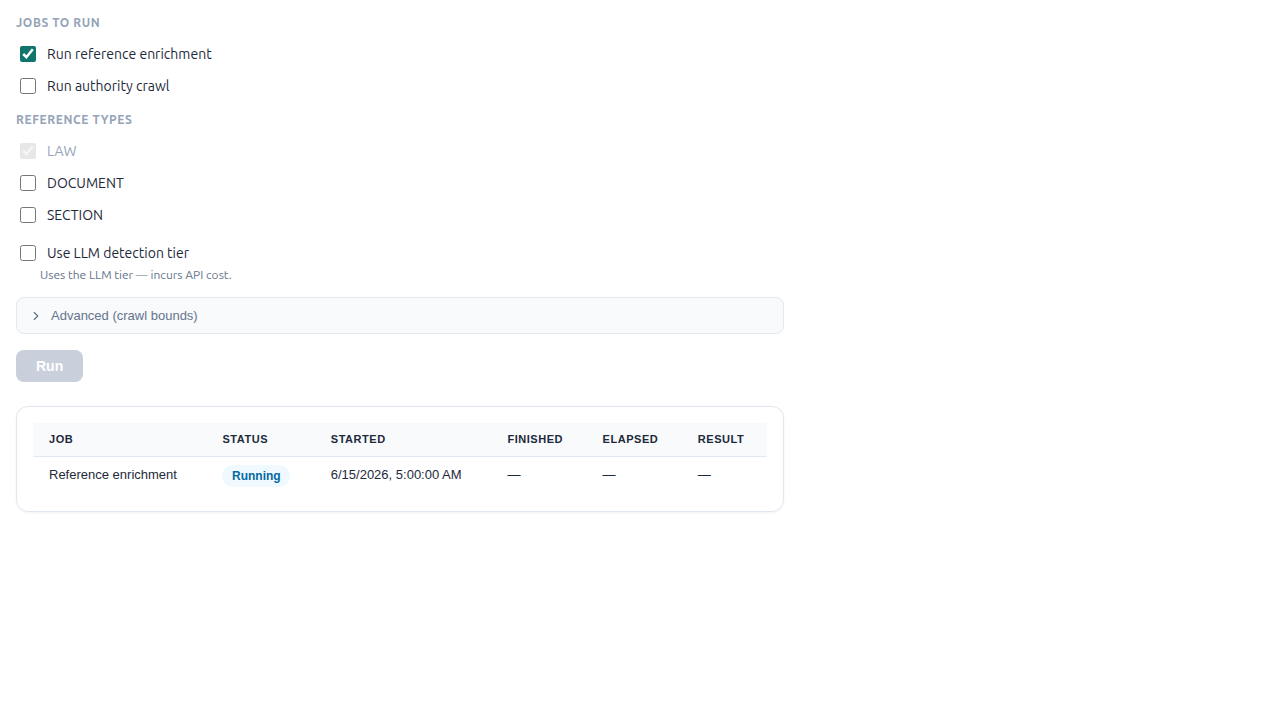
To ingest authorities, tick Run authority crawl, open Advanced (crawl bounds), and set the bounds. The defaults are max_depth=2, min_demand=2, max_authorities=50, per_jurisdiction_cap=15, token_budget=2,000,000 (blank = server default). For a single-source ingest like the shell example, set Min demand = 1 and Max authorities = 1:
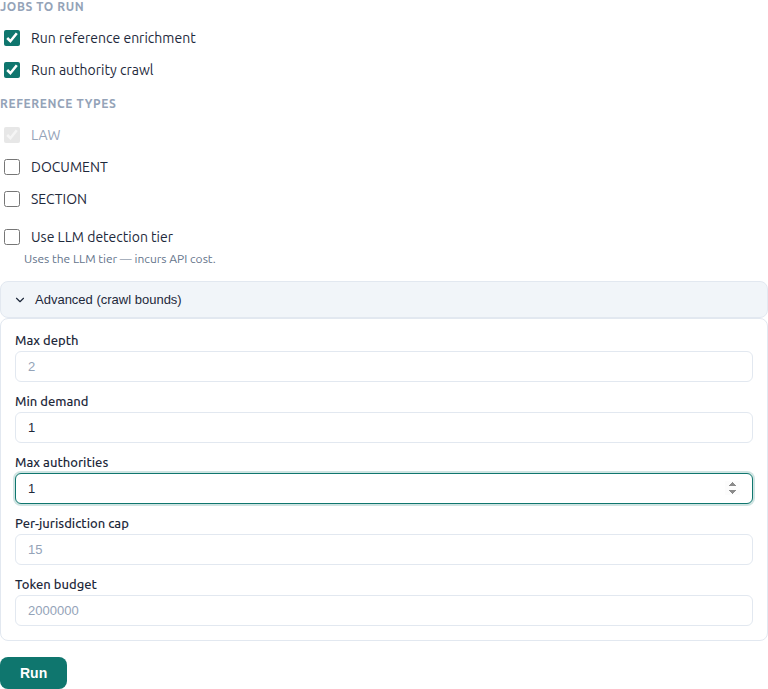
The same finalized-only rule applies: run reference enrichment first (or leave Run reference enrichment ticked alongside the crawl) so the frontier has finalized references to seed from.
Verify it landed¶
- Frontier row —
discovery_state == "ingested",ingested_document_idset,providerstamped with the class name. - Authority document — a
Documentexists whosecustom_meta.canonical_keyequals the requested key (stamped byAuthorityCorpusBootstrapper._stamp_key). - Citing references —
CorpusReference.resolution_statusflippedEXTERNAL → RESOLVED(immediate in Option A; after the Celery relink task in Options B/C), and the resolved doc→doc edge now appears in the governance graph.
Part 2 — Add a provider (flip unsupported → supported)¶
Spotting what needs a provider¶
The read-only Queue tab of the Authority Console at /admin/authority/queue (superuser-only) is the instance-wide ingestion backlog over the whole AuthorityFrontier.
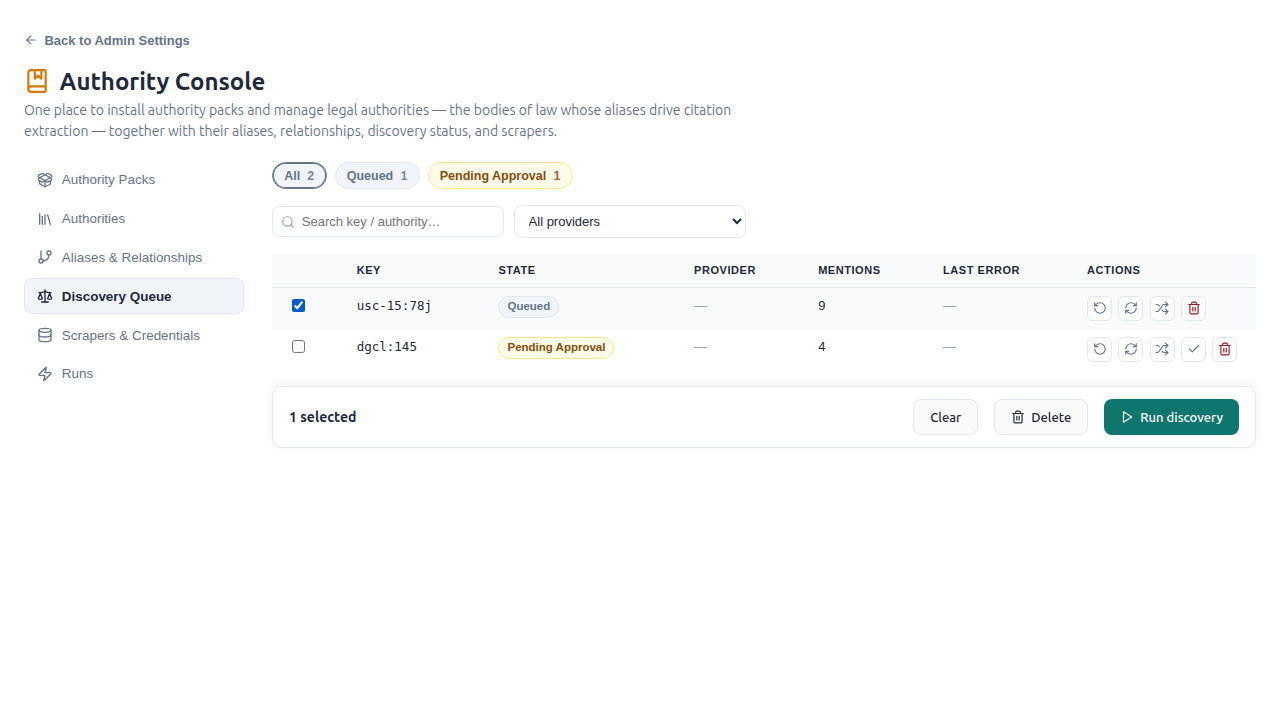
Click the Unsupported state chip to filter to the cited authorities no provider can handle. These — bodies of law with demand but no .gov source the system knows how to fetch — are exactly the candidates for a new provider (or a no-code alternative below).
The provider contract¶
A provider is a subclass of BaseAuthoritySourceProvider (opencontractserver/pipeline/base/base_authority_source_provider.py) dropped into opencontractserver/pipeline/authority_source_providers/. The registry auto-discovers every subclass in that package — there is no manual registration step.
Five class variables (with sensible defaults) and two abstract methods:
supported_prefixes: tuple[str, ...] = ()  # default can_handle(): prefix in supported_prefixes
license: str = "public-domain"            # the gate REJECTS anything else (blocked_license)
priority: int = 100                       # lower = preferred; the agentic fallback is 9999
requires_approval: bool = False           # True -> gate parks at pending_approval (no auto-ingest)
enabled: bool = True                      # False -> excluded from provider selection

def _locate_impl(self, canonical_key, **kw) -> AuthorityRequest   # PURE (no I/O) — derive URL/params
def _fetch_impl(self, request, **kw) -> list[AuthoritySection]    # the HTTP + parse lives here
locate / fetch / can_handle are public wrappers on the base; override can_handle only when a fixed prefix tuple isn't enough (USC and CFR override it with a regex so all titles work without code changes). The output is AuthoritySection(key, heading, text, source_url) — key becomes the document's canonical_key and must match the requested key (or surface the section identifier in the heading), or the gate returns unlocated.
Minimal skeleton¶
"""Texas Business Organizations Code authority source provider (example)."""
from __future__ import annotations

from typing import ClassVar

from opencontractserver.enrichment.authorities import AuthoritySection
from opencontractserver.pipeline.base.base_authority_source_provider import (
    AuthorityRequest,
    BaseAuthoritySourceProvider,
)
from opencontractserver.utils.safe_http import safe_fetch_bytes


class TexasStatutesProvider(BaseAuthoritySourceProvider):
    title = "Texas Statutes"
    description = "Fetches Texas statute sections from <a public-domain .gov source>."
    license: ClassVar[str] = "public-domain"          # MUST be this, or the gate blocks it
    supported_prefixes: ClassVar[tuple[str, ...]] = ("tx-bus-org", "tx-tax")

    def _locate_impl(self, canonical_key: str, **kw) -> AuthorityRequest:
        prefix, section = canonical_key.split(":", 1)        # "tx-bus-org:21.001"
        return AuthorityRequest(
            canonical_key=canonical_key,
            url=f"https://<allowlisted-host>/.../{section}",
            params={...},
            citation=f"Tex. Bus. Org. § {section}",
            extra={"section": section, "source_url": "https://<human-readable-url>"},
        )

    def _fetch_impl(self, request: AuthorityRequest, **kw) -> list[AuthoritySection]:
        body, _ = safe_fetch_bytes(request.url, params=request.params)
        heading, text = _parse(body)                          # your parser
        return [
            AuthoritySection(
                key=request.canonical_key,                    # MUST equal the requested key
                heading=heading,
                text=text,
                source_url=request.extra["source_url"],
            )
        ]
Study cfr_provider.py (a clean single-request XML provider) and us_code_provider.py (ZIP + namespaced XML, with a _load_title_xml seam that tests patch to avoid network) as references.
Three things that make it actually ingest¶
Writing the class is not enough — three gates stand between a registered provider and an ingested document:
- Restart the process. The registry is built once and cached permanently (
functools.lru_cache). Dropping the file in the package is not enough — restart Django and the Celery worker (docker compose -f local.yml up -d django celeryworker).enabled=True(the default) means it goes live on restart. - The source host must be on the public-domain allowlist. The gate rejects any
source_urlwhose host is not inPUBLIC_DOMAIN_SOURCE_HOSTS(opencontractserver/constants/safe_http.py) withblocked_license. Today that set isecfr.gov,federalregister.gov,govinfo.gov,gpo.gov,uscode.house.gov(pluswww.variants). A new host (e.g. a state.gov) must be added there — "every addition is a trust decision." Also notesafe_fetch_bytesenforces HTTPS-only. licensemust be"public-domain"— the first gate check. Anything else is blocked outright.
Verify discovery + routing before crawling:
docker compose -f local.yml run --rm django python manage.py shell -c '
from opencontractserver.enrichment.services.authority_discovery_service import (
    AuthorityDiscoveryService as A,
)
print(A._provider_for("tx-bus-org:21.001"))
# -> ("TexasStatutesProvider", <obj>, "tx-bus-org:21.001")
'
No-code alternatives¶
Two ways to flip unsupported → supported without writing a provider:
- Add an
AuthorityKeyEquivalencerow. If the wanted key is a popular-name/domain key whose text is already a statute an existing provider handles, just add a DB row bridging it (e.g.my-act:5 → usc-12:1841)._provider_forthen fetches the statutory key and the post-ingest relink upgrades the original references. Zero code. - Enable the agentic web locator.
AgenticWebLocatorProviderisenabled=Falseandpriority=9999(absolute last resort). It can attempt any key, but because it isrequires_approval=True, its results park atpending_approvalfor a human to confirm rather than auto-ingesting — the open-vocabulary safety valve. Setenabled=Trueto turn it on.
Verify it ingests¶
Once the provider is registered and its host is allowlisted, re-run the crawl (or Part 1 Option A with one of the now-supported keys). The previously unsupported frontier rows should advance through in_progress → ingested, and the Unsupported chip count on /admin/authority/queue should drop.
Permissions & safety recap¶
runCorpusEnrichment(and therefore the crawl) requires corpus UPDATE; superusers may trigger it on any corpus they can READ without holding UPDATE.- The crawl seeds from finalized references only — irreversible ingestion never acts on a still-running enrichment pass.
- The gate enforces
public-domainlicense + an allowlisted.govsource host + key verification before any text is ingested; agentic results require human approval. /admin/authority/queue(the Authority Console Queue tab) is superuser-gated — it observes the frontier and offers per-row requeue/reset/reroute/approve/delete verbs; triggering enrichment runs stays on the Runs tab (/admin/authority/runs).